
Why a Duplicate Schema WordPress Plugin Has to Know When to Stop
A duplicate schema WordPress plugin problem is easy to miss: two Organization schemas end up on one page, confusing AI systems trying to understand who you are, and no SEO tool flags it as an error because nothing is technically missing.
It deepens the Organization and author schema your SEO plugin already publishes, through that plugin's own public filters, instead of starting a second graph, and stops emitting entirely when it can't tell who owns the graph. IndexMesh for WordPress is a free AI visibility plugin that also controls which AI crawlers reach your site and publishes a curated llms.txt.
Key Takeaways
- Two Organization schemas on one page is a real, documented problem, and no SEO tool flags it as an error since nothing is technically missing.
- IndexMesh enriches the graph your SEO plugin already publishes, through that plugin's own public filters, rather than starting a second one.
- A six-state emission policy decides what happens per provider, and two of those states end in publishing nothing at all.
- Free, works alongside Yoast SEO, Rank Math, All in One SEO, or SEOPress, and sends no data anywhere but the site's own hostname.
- Your SEO plugin's own schema type catalogue stays broader; this is entity depth inside the types that already exist, not a wider type list.
Why is duplicate Organization schema a real problem, not a theoretical one?
Yes, it's real. Two Organization schemas on one page actively confuse the machines reading it, and no SEO tool flags it as an error, because nothing is technically missing. If you run Yoast, Rank Math, All in One SEO, or SEOPress, the fix is to deepen that plugin's existing graph, not publish a second one beside it.
That's how you avoid duplicate organisation schema in WordPress: your SEO plugin's graph already covers Organization, Person, WebSite, WebPage, Article, FAQ, and more, and that graph is the right place to start. A schema management plugin earns its place by deepening what's already inside it.
That second-graph problem is common enough that practitioners actively discuss it. A real audit documented on r/AI_SearchOptimization found a site with three separate Organization schemas and inconsistent company descriptions across pages, none of which triggered a "missing schema" warning because nothing was technically missing. The top reply, from a working practitioner, confirmed the same pattern: "I have had instances where using an SEO plugin has caused you to have both organization and local business schema... multiple organization schemas is a bad thing." A separate r/Wordpress thread names an actual collision between two real named plugins: Yoast and Schema Pro. The test isn't how many script blocks a page has. It's whether two of them claim to be the same thing.
A competing schema plugin like Schema & Structured Data for WP & AMP (100,000+ active installs) generates its own separate schema markup rather than integrating with your existing SEO plugin's output, with no documented handling for the duplicate-schema risk that creates. IndexMesh takes the opposite approach: work inside the graph that exists.
What a duplicate schema WordPress plugin should let you control
Yoast SEO, Rank Math, All in One SEO and SEOPress all publish a connected graph covering Organization, Person, WebSite, WebPage, Article, FAQ, HowTo and other supported types, so the useful question is not what to add but where to put it.
Work inside the graph that exists
Add context through the provider's own public filters, rather than starting a second graph beside the first
Know who owns the graph
Detect the active provider before writing anything, and treat plain WordPress as a different case from a site running two schema plugins
Stop when ownership is unclear
Declining to emit is the correct behaviour in the one state where emitting would cause the problem
Check what is served, not what is configured
The admin screen and the HTML a visitor receives are two different things, and only one of them is what a crawler reads
Yoast owns the graph. IndexMesh for WordPress deepens what is in it.
Why one entity beats two, with the dated evidence behind it. Read the full guide →
The schema emission policy by provider
This is where the duplication problem actually gets solved. IndexMesh applies a six-state emission policy, decided from the provider it detects, and two of those states end in it publishing nothing at all.
Yoast SEO, Rank Math or All in One SEO
- What IndexMesh does
- The plugin enriches the provider's graph in place, through its public filters. It enriches the existing Organization, Person and Article nodes, and appends a genuinely missing eligible node inside the provider's graph. It prints no separate graph of its own
SEOPress
- What IndexMesh does
- The plugin enriches the existing Organization and Article nodes in place, through seopress_get_json_data_organization and seopress_pro_get_json_data_article. SEOPress exposes no whole-graph append filter, so it may publish an eligible node it cannot insert that way, principally an opt-in FAQ node, in a separate supplemental block. It does not publish an author ProfilePage beside SEOPress until you confirm SEOPress does not already output one. It does not repeat Organization or Article there
Plain WordPress
- What IndexMesh does
- The plugin publishes eligible IndexMesh-owned JSON-LD directly. There is no provider graph for it to enrich
A detected provider that owns a graph but has no IndexMesh adapter
- What IndexMesh does
- The plugin publishes eligible standalone JSON-LD rather than silently dropping what you configured, and reports that state in Schema Health
Schema ownership the plugin cannot determine
- What IndexMesh does
- It emits and enriches nothing. It defers rather than guessing
Two or more third-party schema providers
- What IndexMesh does
- The plugin suppresses its own output and its enrichment rather than adding to an ambiguous provider state. IndexMesh suppresses IndexMesh. It never suppresses your SEO plugin
In every case, IndexMesh preserves the provider's own @id values and provider-owned field values, and adds an IndexMesh Organization only where the provider graph doesn't already have one. Before any of this runs, the plugin suppresses both output and enrichment on noindex, private, draft, pending, trashed, and password-protected content, and on any post excluded by hand.
What can you manage in the schema and entities module?
Six areas, each managed in IndexMesh-owned settings or on the native WordPress user profile, and each emitted only under the policy in section 5.
Business identity
- What you manage
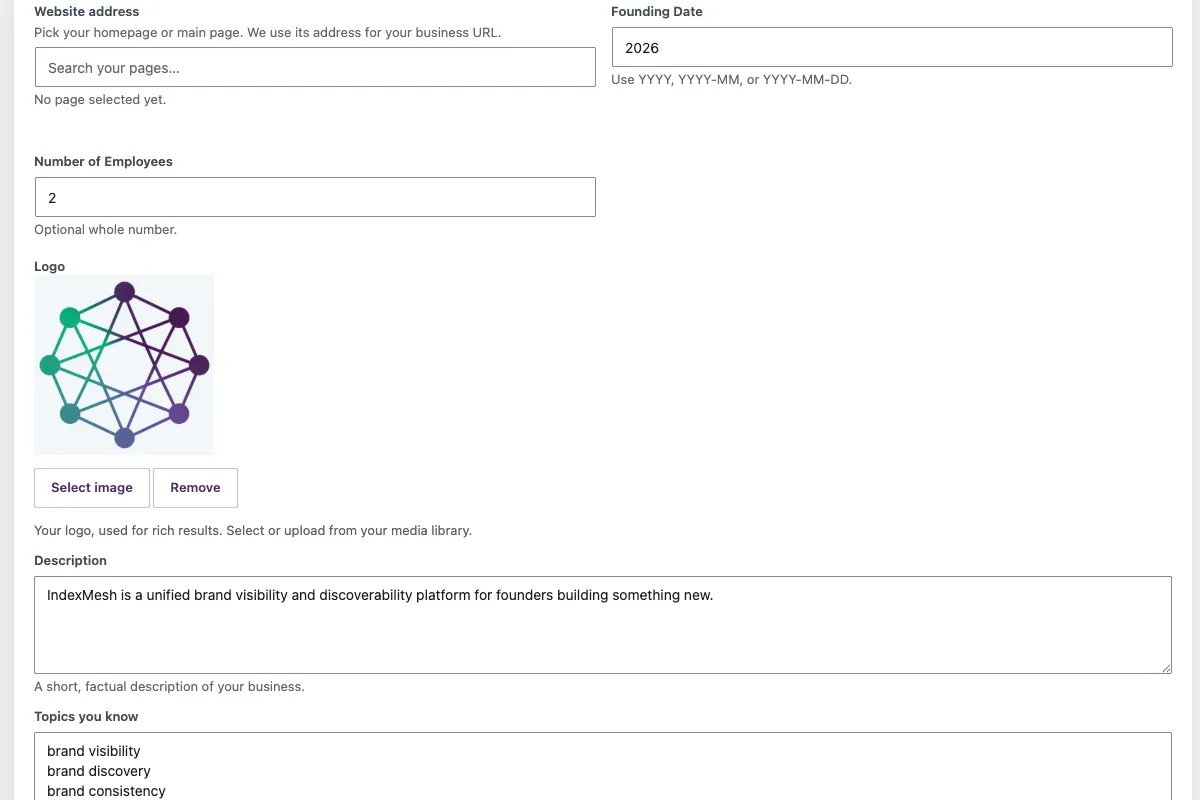
- Legal name, alternate name, brand, slogan, logo, description, founding date, employees, URL and contact point
- Example use case
- A company trading under a short name while its registered name appears on invoices and in directories
- Practical advantage
- One stated form of the name, with the other carried as an alternate rather than contradicting it
- IndexMesh proof
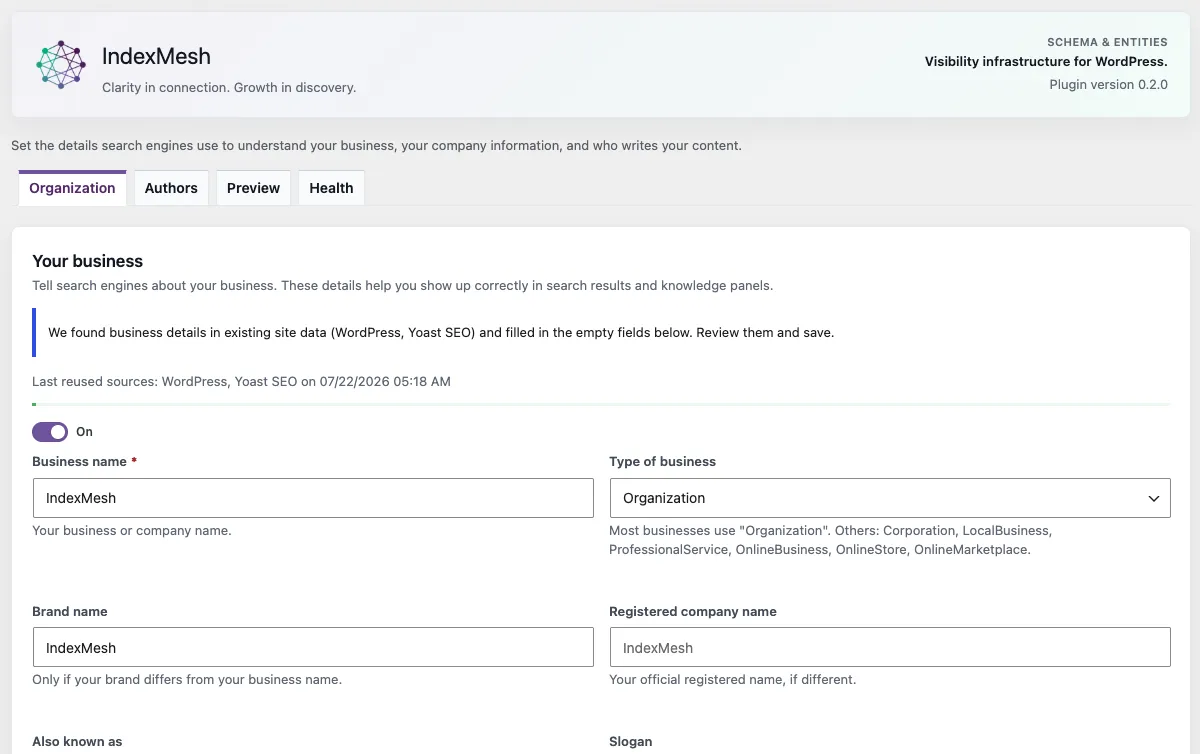
- Organisation tab with a media-library logo picker, and detected WordPress and provider values preloaded into empty fields for review before saving
Identifiers and official profiles
- What you manage
- vatID, taxID, iso6523Code, duns, leiCode, naics, plus the sameAs profiles you actually maintain
- Example use case
- Two firms with near-identical names in the same city and the same trade
- Practical advantage
- An identifier can be matched exactly. A name has to be disambiguated
- IndexMesh proof
- Organisation identifier fields and a sameAs list, emitted or enriched under the emission policy
Relationships, offices and policies
- What you manage
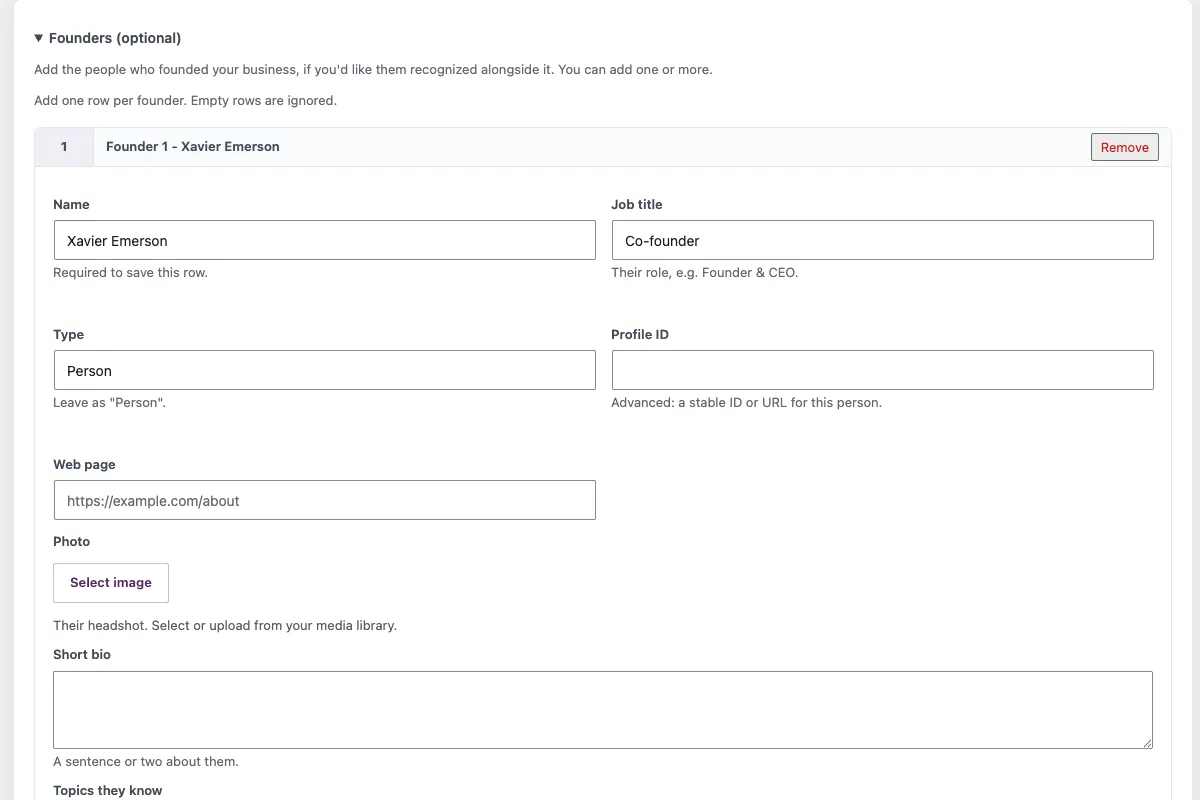
- Founder Person entries, sub-organisations, physical offices with full addresses, and the areas you serve, plus publishing principles including correctionsPolicy, ethicsPolicy and ownershipFundingInfo
- Example use case
- A firm with three offices and a service radius wider than any of them, whose site states one address and implies the rest
- Practical advantage
- Each location is stated, and the area you cover is stated separately from where you sit
- IndexMesh proof
- Founder and sub-organisation entries, an offices list with full addresses, service areas for a multi-location business, and the publishing principles fields on the Organisation tab
Author trust profiles
- What you manage
- Headline, honorific prefix and suffix, job title, employer, headshot, short and full bio, languages, awards, knowsAbout, profile URLs, and identifiers including Wikidata, ORCID and alumni
- Example use case
- A professional-services site publishing expert-led advice under named consultants rather than a house byline
- Practical advantage
- A byline that resolves to a person with stated expertise, instead of a name string a machine has to guess at
- IndexMesh proof
- The IndexMesh Author Schema section on the native WordPress user profile, a completion notice naming the recommended fields still missing, and provider-safe ProfilePage output
Article context
- What you manage
- about, mentions, the assigned reviewer and lastReviewed
- Example use case
- A health or finance page written by one person and checked by another before it went live
- Practical advantage
- The subject, the mentions and the review are stated where a machine reads them, not implied by the prose
- IndexMesh proof
- Post editor fields, with reviewer assignment gated by capability and a reviewer who is not the author by default
Readiness and ownership
- What you manage
- Nothing is written here. You read the detected provider, the emission decision, the supported helpers and the caveats
- Example use case
- A site where the theme also emits structured data and nobody is sure what wins
- Practical advantage
- You can see what the plugin will do before it does it
- IndexMesh proof
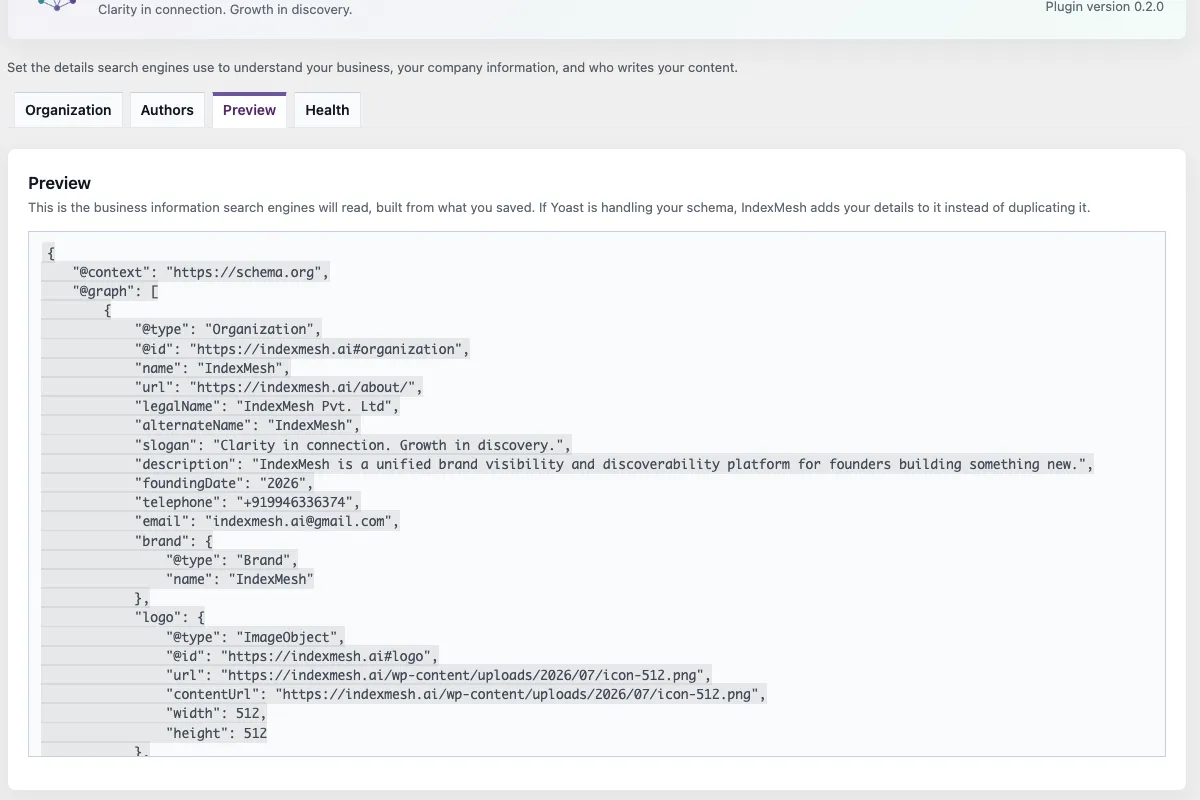
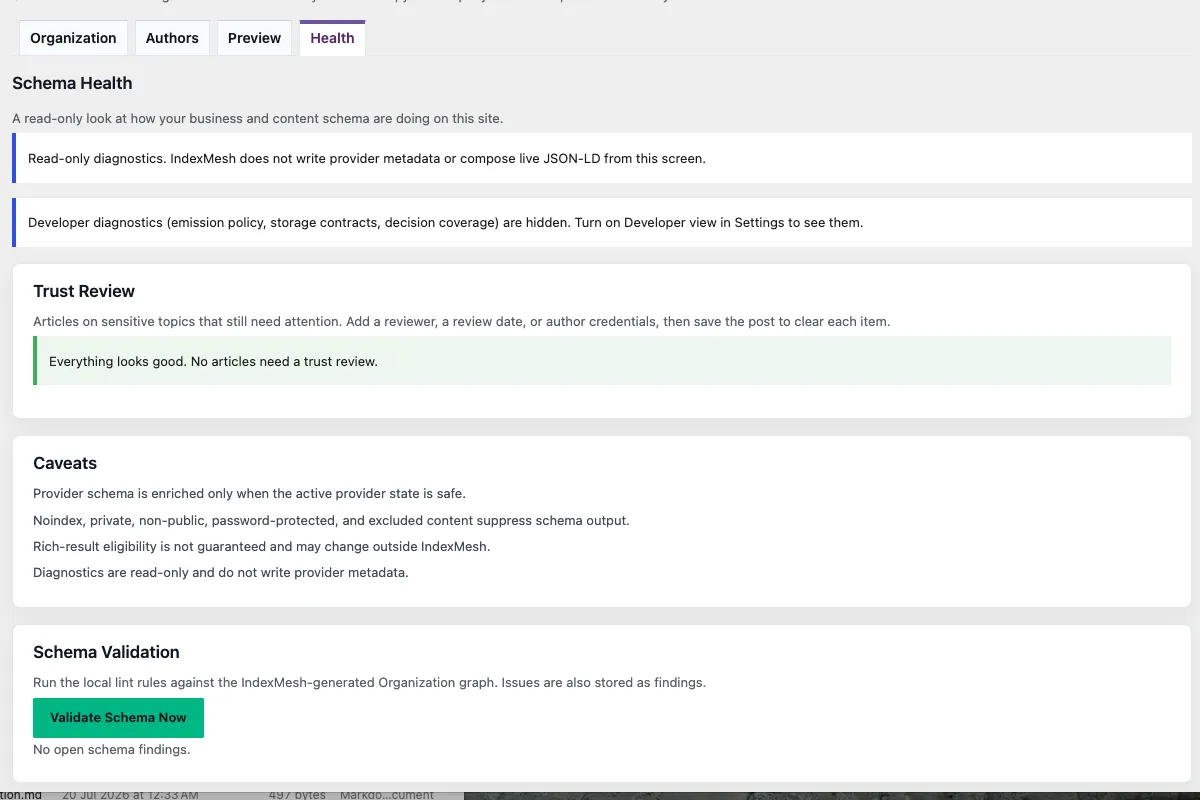
- Read-only Schema Health, a preview of the generated Organisation JSON-LD, and a read-only diagnostics route
What the screens actually look like
The organisation tab, prefilled from values already on the site, and the author profile fields that carry a byline's expertise.
How this works alongside Yoast, Rank Math, All in One SEO, and SEOPress
No, and the reason is that it never starts a graph of its own where one already exists.
Keep the SEO platform you already trust. IndexMesh is not another one: it is an AI-discovery governance layer that sits around it.
Yoast SEO
- What it already provides
- A strong connected schema graph covering Organization, Person, WebSite, WebPage, Article, FAQ, HowTo and other supported types
- How IndexMesh differs
- Guided organisation and entity setup, prefill from WordPress and detected site values, business identifiers and official profiles, founders and sub-organisations, offices, addresses and policies, author trust profiles with completion guidance, and Article about, mentions, reviewer and lastReviewed context
- How they coexist
- Yoast owns and connects the graph. The plugin adds that context through Yoast's own public schema filters rather than asking you to replace it
Rank Math
- What it already provides
- Its own connected graph
- How IndexMesh differs
- The same guided entity context
- How they coexist
- Whole-graph enrichment through the provider's public filter
All in One SEO
- What it already provides
- Its own connected graph
- How IndexMesh differs
- The same guided entity context
- How they coexist
- Whole-graph enrichment through the provider's public filter
SEOPress
- What it already provides
- Its own graph, with per-node filters
- How IndexMesh differs
- The same guided entity context
- How they coexist
- The plugin enriches Organization and Article in place. An eligible node SEOPress cannot accept is published separately with its own identity
Plain WordPress
- What it already provides
- No entity graph
- How IndexMesh differs
- The whole module
- How they coexist
- The plugin publishes eligible JSON-LD itself, because there is no graph to enrich
Provider behaviour and the evidence behind it live on the SEO plugin compatibility page .
Entity depth versus type breadth
Your SEO plugin's schema catalogue is broader than IndexMesh's. Yoast, Rank Math, All in One SEO, and SEOPress already cover Organization, Person, WebSite, WebPage, Article, FAQ, HowTo, and other supported types. That breadth isn't the claim here. A duplicate schema WordPress plugin that just added more types would miss the point. What IndexMesh adds is entity depth inside the types that already exist, provider-safe emission, and ownership control, through guided setup for business identity, identifiers, founders, offices, and author trust profiles that a general SEO plugin doesn't walk you through field by field.
What the schema and entities module of IndexMesh for WordPress doesn't do
Stated here rather than discovered after installing.
- FAQ is the only public type helper QAPage, HowTo, ClaimReview and Speakable are not public product features in this release, and the plugin does not manage EducationalOccupationalCredential
- No durable findings history The findings table is deliberately not installed and the audit log table is not created in this release, so there is no cross-session record of what a check found
- Validation is not a publish gate It runs against the already-published page. A visible-byline mismatch is a local warning, not a block on publishing
- Suppression is real, not a warning Where ownership is ambiguous or two third-party schema providers are active, you get no schema from the plugin until the ambiguity is resolved
- No citation reporting of any kind The plugin does not track, measure or report whether an AI system cited you, and does not calculate a visibility score
- Type breadth is not the claim Your SEO plugin's schema catalogue is broader. What is here is entity depth, provider-safe emission and ownership control
Does the plugin send my site's data anywhere?
No. IndexMesh for WordPress does not send this data to IndexMesh or to any third party. Everything here is stored in your own database: IndexMesh-owned settings for the organisation, and native WordPress user meta for the author fields. The one outbound request this module makes fetches a post's own rendered page, to check the schema on the live page rather than the admin screen, and it goes to your own hostname.
Current release is version 0.2.0, tested on WordPress 6.5 and later, through WordPress 7.0, and PHP 8.1 and later.
See the full IndexMesh for WordPress feature set →
Common questions
Will IndexMesh collide with the SEO plugin I already run?
No. IndexMesh for WordPress never starts a graph of its own where one already exists. Yoast, Rank Math, and All in One SEO keep owning and connecting the graph; IndexMesh adds founder, identifier, and author context through that provider's own public schema filters.
Does IndexMesh replace Yoast, Rank Math, All in One SEO, or SEOPress?
No. IndexMesh for WordPress is not another SEO platform, it's an AI-discovery governance layer that sits around the one you keep. Schema is one of many things a full SEO platform does; IndexMesh focuses on entity depth, safe enrichment, and ownership control.
What happens if I have two schema plugins active at once?
IndexMesh for WordPress detects that state and suppresses its own output and enrichment rather than adding to an already-ambiguous graph. It suppresses itself, never your SEO plugin, and reports the state in Schema Health.
How do I add my founders as Person entities instead of a generic byline?
Set founder entries on the Organization tab, with name, job title, knowsAbout, and sameAs profile links. Each becomes a linked Person entity in the Organization schema rather than a name string. Author-level trust profiles for bylines are set separately, on the native WordPress user profile.
Does IndexMesh work with plain WordPress, no SEO plugin at all?
Yes. With no existing graph to enrich, IndexMesh publishes eligible IndexMesh-owned JSON-LD directly.
Why does IndexMesh still support FAQ schema if Google retired the FAQ rich result?
Because rich results and AI answer engines aren't the same audience. Google retired the FAQ rich result from search listings in 2026, but FAQ schema is per post, opt-in, and shipped here for answer engines that still read it, not for a search-result feature that no longer exists.
Does adding more schema actually get my brand cited by AI?
No guarantee either way, and be sceptical of anyone claiming otherwise. Schema mainly reduces ambiguity about who you are; it doesn't create authority an AI system has a reason to cite. Real third-party mentions and a consistent entity footprint do more for citations than schema depth alone.
Set the entity up once, in one place
IndexMesh for WordPress manages your organisation, author and Article context in IndexMesh-owned settings and on the native WordPress user profile, then applies the emission policy above to decide where it belongs.
It enriches your provider's own graph through that provider's public filters, publishes a separate node only where a provider cannot accept one in place, and stops entirely when it cannot tell who owns the graph. It is free and works with Yoast SEO, Rank Math, All in One SEO, SEOPress and plain WordPress.
Field-by-field setup, from the Organisation tab to the user profile. Configure it →