
Only About One in Four Brand Mentions and Citations Line Up
Brand mentions and citations are not the same thing, and the research on both tells a consistent story, for founders with no in-house PR or SEO team deciding where to spend limited time: mentions alone do not prove that an AI system will cite the brand. AI brand citations come from consistent, independent agreement across sources the brand does not own, not the volume of mentions by itself, and that off-site evidence is what IndexMesh's brand-visibility work is built around.
An eight-category check. No email required.
Brand Mentions and Citations, in Short
See how IndexMesh handles the on-site half of this →
- 84% of AI citations trace to earned media, not paid placement, and unlinked brand mentions correlate with AI visibility roughly three times more strongly than backlinks.
- 85% of brand mentions happen on pages the brand does not own; being mentioned and being cited are not the same thing, and only about one mention in four carries a citation.
- Community threads, video, review platforms, and earned editorial are where corroboration actually accumulates, not the brand's own site.
- On-site identity and off-site corroboration are two separate jobs; this page covers the off-site half no plugin alone can earn for you.
What is a brand mention?
A brand mention is any time your name appears on a page you do not own: a review, a forum answer, a roundup, a comparison article, a video description. It does not need to link back to you. AI systems read the mention itself, not just the link.
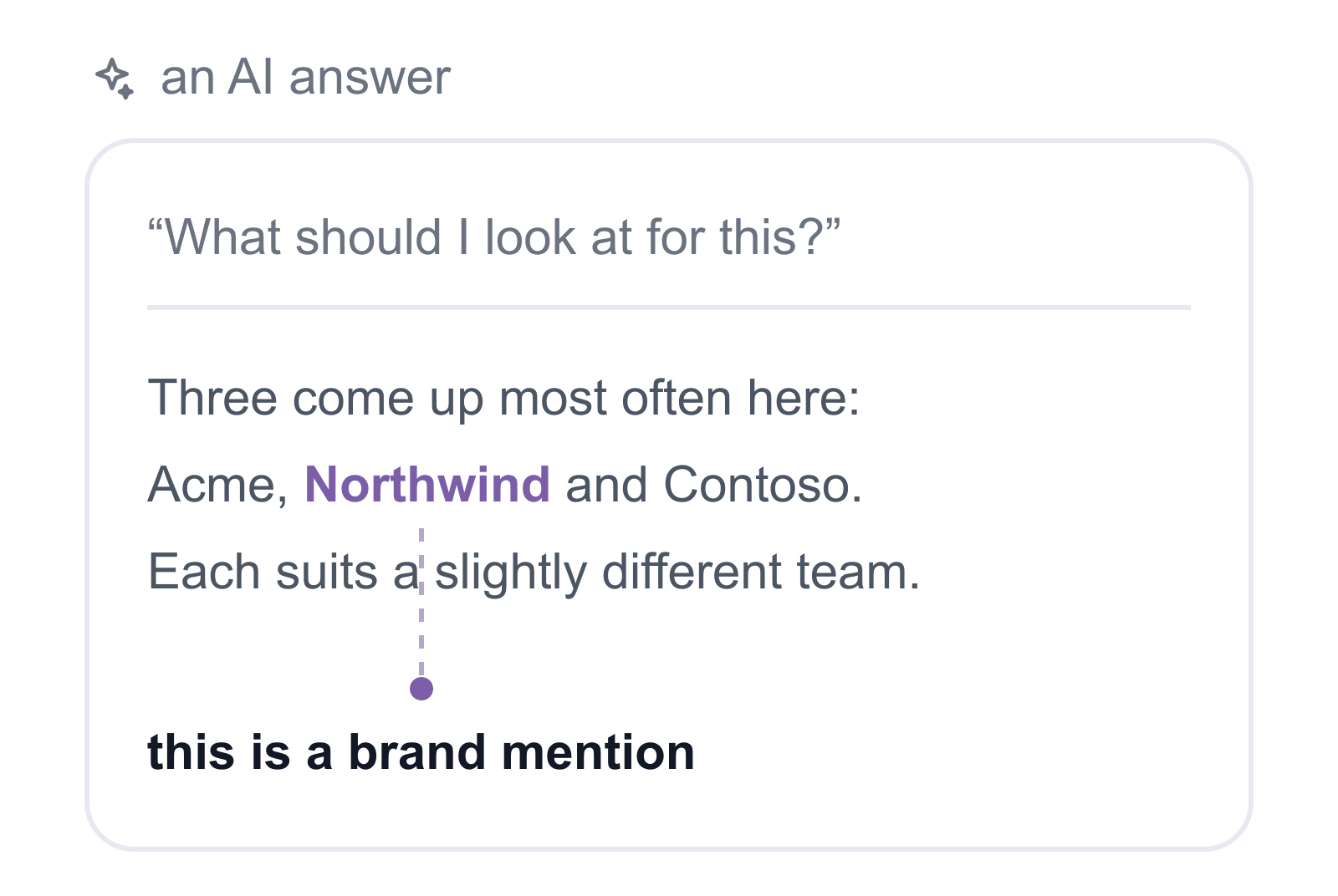
That distinction matters for AI visibility specifically. If someone asks an AI assistant "what should I look at for this?" and the answer says "Acme, Northwind, and Contoso each suit a slightly different team," each of those three names is a brand mention, whether or not any of them are hyperlinked. It is also the raw material of what gets a brand cited by AI in the first place.
Brand Mentions and Citations: Four Findings From the Research
Four findings, drawn from three independent studies, describe most of what makes AI cite a brand.
84% of AI citations come from earned media
Muck Rack analysed more than 25 million links cited by ChatGPT, Claude and Gemini across 17 industries. Paid and advertorial content accounted for 0.3%.
3x mentions beat backlinks by roughly three to one
Ahrefs studied 75,000 brands. The full ranking is below. Ahrefs are clear these are correlations, not causes, and moderate ones.
85% of brand mentions happen on pages you do not own
AirOps tested GPT-5, Claude Sonnet 4.5 and Perplexity Sonar. The brand’s own domain accounted for 13.2%.
0.737 YouTube mentions are the strongest single signal measured
Ahrefs, same study. Ahead of every other individual factor tested.
Ahrefs ranked eleven signals. The top three are all off-site.
| What was measured | Correlation with AI visibility |
|---|---|
| Branded web mentions | 0.664 |
| Branded anchors | 0.527 |
| Branded search volume | 0.392 |
| Domain Rating | 0.326 |
| Referring domains | 0.295 |
| Branded traffic | 0.274 |
| Backlinks | 0.218 |
Why corroboration is what actually moves the needle
A claim is not evidence until something independent agrees with it.
An AI system recommending something has to decide what it can safely assert.
One source saying a thing is a claim. It carries the uncertainty of its single origin. What can resolve that uncertainty is agreement: a review platform, two community threads, a comparison article and a video all describing you the same way.
Below that threshold you are a brand that says things about itself. Above it you are a brand that other people describe consistently.
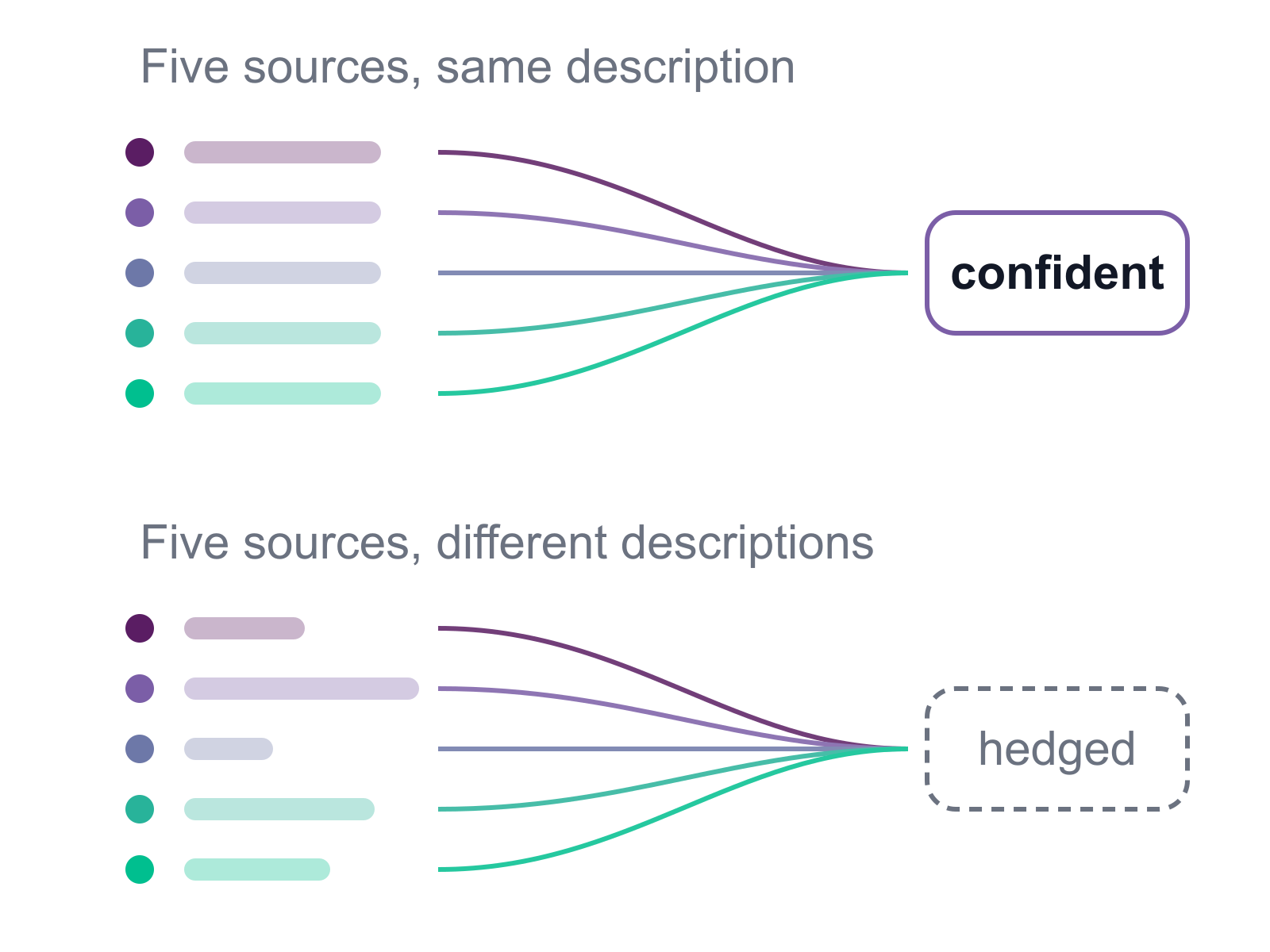
Five sources that describe you differently do not corroborate anything. They give the system five reasons to hedge.
Backlinks vs mentions: they are not the same lever
Backlinks vs mentions is a real distinction AI-visibility work has to hold onto, because they optimise for different systems. Backlinks still matter for traditional search ranking. For AI visibility specifically, the evidence favors mentions by a wide margin, and the same asset does not serve both jobs equally.
Being mentioned and being cited are not the same thing either. Most of the time an AI system names a brand, it does not link to it.
| What it is | What you can do about it | |
|---|---|---|
| Mention | Your name appears in the answer | Earn corroboration. This is the part you can influence |
| Citation | The answer links to a source | The system decides. Roughly one mention in four gets one |
| Neither | You are not in the answer at all | The problem the rest of this page is about |
BuzzStream analysed 12,000 AI answers across Google AI Mode, AI Overviews, Gemini and GPT-5.4-mini in July 2026. 23.1% of brand mentions carried a citation in the same answer.
The rate moves with the question, not with you. Ask about one brand and 39% of mentions carry a citation. Ask for a list of options and it falls to 7.2%.
Chasing citations means optimising for something you do not control. Being mentioned at all is the part that responds to work.
Where brand mentions actually come from
The research converges on four channels.
Community conversations
Reddit, Quora, niche forums, the places your buyers ask questions before they decide. Reddit carries a large share of the social citations ChatGPT and Perplexity draw on. Genuine participation, not link drops, and slow.
Creator and video content
YouTube in particular. A review or walkthrough by someone who is not you is high-value corroboration.
Third-party review platforms
G2, Capterra, Trustpilot and their category equivalents. Structured, comparative, heavily drawn on for anything purchase-shaped.
Earned editorial
Coverage, roundups and listicles. AirOps found nearly 90% of third-party mentions come from listicles, comparisons and roundups rather than feature coverage, which is a much lower bar than a press campaign.
The list leaves things out, and the omissions are the point.
| Kind | Who says it | Where it sits | What it is worth to an AI system | What it is still good for |
|---|---|---|---|---|
| Counts as corroboration | Someone who is not you | A domain you do not own | Independent agreement | Conversion, once someone is already looking |
| Does not | You | Your blog, your landing pages, your own social | A claim awaiting agreement | Everything the left column does not do |
Owned content still has a job. It is what converts someone once they are already looking, and it is where schema markup for AI search states entity clarity in machine-readable form. It just is not the evidence that earns AI citation for a brand.
Those places are not an accident. They are where discovery actually happens now.
What to do about it
Most articles here end with a tactics list and a tracking tool. This is the version that is true.
Fix your identity first.
Every mention you earn points at an entity. If your name, description and category vary across platforms, mentions accumulate against several slightly different entities instead of one. Schema and entity markup is how you state that identity in the form machines read. IndexMesh for WordPress enriches the existing schema graph your SEO plugin already publishes instead of adding a second, competing node, so the on-site half of that identity doesn't quietly contradict the mentions you're earning off-site. See how IndexMesh for WordPress handles schema and entities →
Be genuinely present where the conversations happen.
Not campaigns. Presence. Answering questions in the communities where your buyers already are, under your own name, over months. It is the highest-value channel and the slowest.
Get onto the review platforms that matter for your category.
Structured, comparative, and disproportionately cited. Most early companies simply have not claimed their listings.
Aim at roundups rather than features.
Being included in "best tools for X" is both easier and, according to the data, more useful than a feature article.
Then measure, and expect it to be slow.
Live-retrieval systems like Perplexity and AI Overviews can reflect new content within weeks. Models that lean on training data take considerably longer.
There is no version of this that works in two weeks. Anyone selling that timeline is selling something else.
Building consistent presence across how buyers actually find products now and keeping that presence consistent everywhere it appears are the two pieces of this work IndexMesh's guidance focuses on.
The Rest of This Work
This page covers what earns a citation. The rest of the same off-site work:
AI Search Brand Visibility
Why 96% of B2B brands are invisible in AI-driven discovery, not from poor quality but from evidence living in only one place. The eight-category self-check shows exactly where that evidence needs to exist instead.
AI Brand Discovery
The buyer-journey shift that now forms a shortlist of two or three names before anyone visits a website. Awareness, consideration, and decision all work differently once an assistant is doing the comparing.
Brand Consistency Across Platforms
What turns scattered mentions into evidence about one entity instead of several. When sources disagree on your name, description, or category, an AI system treats that as a reason to hedge rather than cite you.
AI Visibility Infrastructure
A mention only becomes a citation if the AI system that finds it can also reach and correctly parse your own site, the technical layer this page assumes is already in place.
Brand Trust Signals
A mention says other sources talk about you. A review says a customer rated a specific experience and put a number on it, a different and stronger credibility signal.
Built by people who have to answer this question honestly
IndexMesh's founders, Xavier Emerson and Leenat Rose, read this same research before writing a word of IndexMesh's own off-site guidance, because the alternative was giving advice the platform's own presence didn't follow.
Common questions
Eight questions people ask about what actually gets a brand cited by AI.
Something not answered here?
Do brand mentions need to include a link?
No, and that is the surprising part. The Ahrefs study measured unlinked mentions and found they correlated with AI visibility roughly three times more strongly than backlinks did.
Are brand mentions more important than backlinks now?
For AI visibility, the evidence says yes by a wide margin. Backlinks still matter for traditional search ranking. They are different systems and the same asset does not serve both equally.
Which platforms produce the most valuable mentions?
It depends on the system; no single platform leads everywhere. Wikipedia is prominent for ChatGPT, Reddit carries much of what ChatGPT and Perplexity draw on socially, and YouTube carries most of what Google’s AI Overviews draw on. Review platforms and roundup articles follow behind those.
Can a brand just buy mentions or placements?
Paid and advertorial content accounted for roughly 0.3% of AI citations in the Muck Rack analysis. Whatever else paid placement achieves, it is not this.
How long before mentions affect what AI says about a brand?
Systems that retrieve live, such as Perplexity and AI Overviews, can reflect new sources within weeks. Systems relying more on training data take months. Neither is fast.
How many mentions does a brand need?
There is no threshold anyone can give you honestly. What matters is that several independent sources describe you the same way. Five sources that contradict each other are worse than two that agree.
Does posting more on your own blog help?
Not for this. Your own publishing earns its place for other reasons, but the research measures mentions on pages you do not own, and your blog is not one of them.
Will this get a brand cited by AI?
We will not promise that. Systems decide what to cite and nobody controls it. What is within reach is being described consistently by enough independent sources that citing you is the easy choice.
Get IndexMesh for WordPress free →
Last updated
- Evidence last checked:
- Editorial guidance last reviewed:
We review this reference at least quarterly, because the research this page rests on is still being published.
Mesh AI is being built to earn the corroboration this page describes.
Presence on the right platforms, saying the same thing, is slow work done by hand.
Mesh AI is being built as one system for all of it, rather than another tool to add to the list. It cannot make an AI system mention you, and we will not claim it can.
Mesh AI is in build. There is no launch date yet, and we will not invent one.
One email when Mesh AI opens. Unsubscribe in one click.
Building something now and want to talk before then? Leenat runs our operations and reads every message.
We will tell you when it is ready.
One email when it is ready. After that, only when there is something genuinely worth reading. Unsubscribe in one click.