
The Buyer Journey Now Runs Through AI Brand Discovery First
Buyers can now describe a problem to an assistant and get a shortlist back before they visit anyone's website. Where that happens, the competitive decision is made in a space brands cannot see and did not take part in. That is AI brand discovery, the off-site stage IndexMesh addresses.
An eight-category check. No email required.
AI Brand Discovery, in Short
See where you're covered · What actually gets a brand mentioned
IndexMesh for WordPress covers the one on-site piece of this: it groups AI crawlers by function so you can choose which ones reach your site, since a blocked crawler cannot build the knowledge an assistant later draws the shortlist from.
- 94% of business buyers now use AI somewhere in the buying process, and the shortlist a system returns is usually two or three names, not a results page.
- By the time a buyer contacts you, the shortlist is typically already set; first contact confirms a decision rather than starting one.
- Answer engines pull from community threads, review platforms, editorial coverage, and reference sites more than from your own website.
- IndexMesh's off-site brand-visibility work targets exactly this earlier, unmeasurable stage, not the website itself.
What Is AI Brand Discovery?
Brand discovery is the stretch before anyone knows your name: how someone goes from having a problem to having a shortlist, covering the question they ask an assistant, the sources that get read, and the two or three names that come back. You are either in that answer or you are not, and it happens without you.
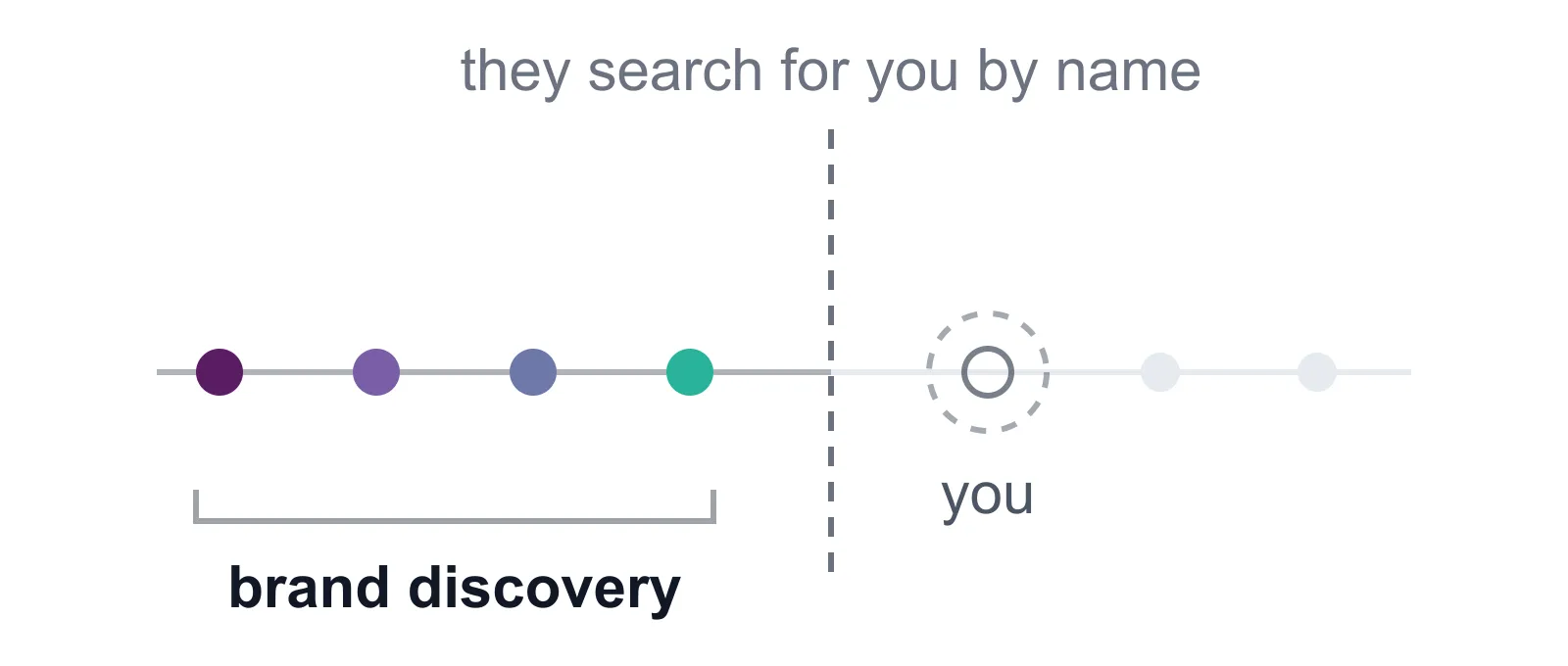
The rest of that stretch, the question, the sources, the names, all happens before they ever search for you specifically.
How buyers find brands with AI: the shortlist forms before anyone contacts you
Two findings from Forrester's 2025 Buyers' Journey Survey frame the shift.
94% of business buyers now use AI somewhere in the buying process.
Forrester, Buyers' Journey Survey, 2025. Up from 89% the year before. Forrester do not publish the sample size.
61% are using AI tools their own employer gave them, inside the firewall.
Same survey. More than half of ChatGPT and Copilot users are on private versions.
The stages of the buyer journey did not change. What happens inside each one did.
| Then | Now | |
|---|---|---|
| Where it starts | A keyword in a search box | A problem described in plain language |
| What comes back | Ten links, plus ads, plus related searches | Two or three names |
| Who compares | The buyer, across eight tabs | The assistant, inside the answer |
| When you find out | A form fill, a demo request | After the shortlist is already set |
| What you can see of it | Referrers, queries, sessions | Almost nothing |
By the time a buyer contacts you, the shortlist is usually already set.
Three stages. All three work differently now.
Click through to see what is different inside each one.
Awareness
Then: The buyer typed a keyword into a search engine and worked through the results.
Now: The buyer describes the problem in their own words to an assistant, and receives categories of solution before a search engine is involved. They may never form a keyword at all.
What that means for you: You are being included or excluded at a stage you cannot observe, based on sources that are not yours.
Consideration
Then: The buyer opened eight tabs and compared.
Now: The assistant compares for them, inside the answer. Most systems cite only a handful of sources per response, so the shortlist is short by construction.
What that means for you: There are far fewer places on the list than there were results on a search page.
Decision
Then: The buyer contacted several suppliers and evaluated.
Now: By the time anyone gets in touch, the choice is usually made. First contact confirms a decision rather than beginning one.
What that means for you: Your sales process starts later than you think, and your visibility work has already decided the outcome.
If you are not present during the first two stages, you are not losing at the decision stage. You were never on the list.
Why brand discovery changed: answers replaced results, and answers are short
A results page could afford to be generous. An answer cannot.
An assistant asked to recommend a tool names two or three, because a list of twenty is not an answer. The format itself compresses the field, and the mechanism for filling those few positions is no longer ranking.
Ten positions became three
Being seventh on a results page was worth something. There is no seventh place in an answer.
Ranking became agreement
A system fills those places with what it can say confidently, which tends to mean what several independent sources already say.
Because the answer arrives before anyone visits a website, most of it leaves no trace in your analytics. Traffic can hold steady while your position in the decision collapses.
Where AI answer engines actually look
Not your website, mostly. AI answer engine discovery draws from sources most brands never think to check, and if the answer is assembled from sources, the obvious question is which ones.
Community threads
Reddit, Quora and niche forums, where people ask the question before they know the vocabulary. Prominent among the social sources several major systems draw on.
Review platforms
Structured, comparative and written by someone other than you. Heavily drawn on for anything purchase-shaped.
Video and editorial coverage
Walkthroughs, roundups, and comparisons from people who do not work for you.
Reference sites
Wikipedia and its category equivalents, prominent for some AI answer engines and close to absent for others.
Your own website still matters. It is where a buyer lands once they have decided you are worth a look. It is not what put you in the answer.
Be present earlier than feels necessary
Most founders start at the decision stage, because it is the only one they can see.
Work backwards from the stage you cannot observe.
A better website, a clearer pitch, and a sharper demo are all useful, and all of them reach buyers who already found you. The stage that decided the outcome happened earlier.
Be present in the sources before the query happens.
None of it can be assembled on demand. A system answering a question this afternoon draws on what was already there this morning.
Accept you will not see it working for a while.
The stage that matters most is the one that leaves the least trace. That is uncomfortable, and it is not a reason to work on the stage you can measure instead.
That is slower and less satisfying than a campaign. It is also the only part that compounds.
Where you are probably missing →
Once you are present somewhere new, say the same thing there →
The Rest of This Work
This page covers the buyer journey. The rest of the same off-site work:
AI Search Brand Visibility
Why 96% of B2B brands are invisible in AI-driven discovery, not from poor quality but from evidence living in only one place. The eight-category self-check shows exactly where that evidence needs to exist instead.
Brand Mentions and Citations
Mentions and citations are not the same thing: unlinked mentions correlate with AI visibility roughly three times more strongly than backlinks, but only about one mention in four earns an actual citation. Four independent studies describe where that corroboration comes from.
Brand Consistency Across Platforms
What turns scattered mentions into evidence about one entity instead of several. When sources disagree on your name, description, or category, an AI system treats that as a reason to hedge rather than cite you.
AI Visibility Infrastructure
Being read into the shortlist depends on AI systems being able to reach and correctly parse your site in the first place, a separate, technical layer underneath the buyer-journey story above.
Brand Trust Signals
Making the shortlist is one thing; being trusted enough to cite is another. Reviews and named, verifiable expertise are the signals that decide it.
Mesh AI puts you in the places the answer gets built from.
Being present early is the part that decides the outcome, and the part nobody has time for.
Mesh AI is being built as one system for all of it, rather than another tool to add to the list. It cannot make an AI system mention you, and we will not claim it can.
Mesh AI is in build. There is no launch date yet, and we will not invent one.
One email when Mesh AI opens. Unsubscribe in one click.
Building something now and want to talk before then? Leenat runs our operations and reads every message.
Built by people who have to answer this question honestly
IndexMesh's founders, Xavier Emerson and Leenat Rose, built IndexMesh's own off-site presence against the same three stages described above, before writing guidance telling anyone else to do it.
Common questions
Eight questions people ask about how buyers actually find products with AI now.
Have a question this didn't answer? Talk to us directly, Leenat runs operations and reads every message.
Are people really searching less?
Search volume has not collapsed. What is changing is the route: queries that once ended in a click can now resolve inside an AI answer, and some begin inside an assistant rather than a search box. The change is in the route, not the demand.
If buyers do not visit my site, how do I measure any of this?
Imperfectly, and that is the honest answer. Traffic no longer reflects consideration. The practical approach is to test the questions your buyers actually ask across the major assistants on a regular cadence and record whether you appear, where, and who appears alongside you.
Does traditional SEO still matter?
Yes, for the traffic that still arrives that way, and because well-structured content remains readable by both systems. It is necessary and no longer sufficient. AirOps found around 85% of brand mentions come from external domains rather than the brand’s own site.
Which stage should a small team focus on?
Awareness, which is counterintuitive because it is the least measurable. It is also the stage where the shortlist forms, and no amount of decision-stage polish rescues a brand that was never shortlisted. That is how buyers find brands with AI, well before a demo ever gets booked.
How long does it take to appear in AI answers?
Systems that retrieve live can reflect new sources within weeks. Systems that rely more heavily on training data take months. Plan in quarters.
Do buyers really not visit websites any more?
They do, but later than they used to. The site is where someone lands once they have decided you are worth a look, which means it converts a decision it no longer starts. The stage that decided it happened somewhere you could not see.
Is this just SEO with a new name?
There is real SEO work inside it, but it is not sufficient alone. Ranking well puts your page in a results list. This page is about the earlier stage, where a system assembles an answer from sources across the web, and most of them are not yours.
Which assistants should a small team care about?
The honest answer is that no single one leads everywhere, and picking a favourite is how people waste six months. The sources they draw on overlap far more than the systems differ, so work on the sources rather than the systems.
Last updated
- Evidence last checked:
- Editorial guidance last reviewed:
We review this reference at least quarterly, because the research this page rests on is still being published.

We will tell you when it is ready.
One email when it is ready. After that, only when there is something genuinely worth reading. Unsubscribe in one click.