
A founder brand visibility platform builds what your website can't.
IndexMesh is a unified brand visibility and discoverability platform for founders building something new. We help you get found, not just by Google, but by the AI tools people now ask instead: ChatGPT, Claude, Perplexity. Most of that work is off-site presence: the platforms, profiles, and communities those systems actually check, not your own website.
Eight categories. About a minute. No email required.
The Facts That Matter
Citations trace mostly elsewhere
Agreement beats self-claims
One identity, everywhere
Plugin free now, Mesh AI in build
Being good at SEO is no longer the same as being found.
Three numbers from 2026 explain why a good website isn't enough on its own.
84%
of AI citations trace to sources other than the brand’s own website.
Muck Rack, May 2026. 25 million links analysed across ChatGPT, Claude, and Gemini, spanning 17 industries.
85%
of brand mentions happen on pages the brand does not own.
AirOps, tested across GPT-5, Claude Sonnet 4.5, and Perplexity Sonar.
4%
of companies show up while a buyer is still describing the problem.
An index of 70 B2B companies. The other 96% show up only once the buyer already knows the company’s name.
In plain terms: you can have a clean site and good rankings, and still have no brand visibility with the tools people actually ask. People can find you if they already know your name. Almost nobody arrives on their own.
Why this happens: one voice versus many.
AI systems don't decide what to say about a brand by reading its homepage. They look for agreement: do several unrelated sources say the same thing about you? If they do, that's evidence. If only you say it, that's just a claim.
Most early-stage brands only exist in one place: their own site, praising itself. That's not neglect. It's what happens when a brand gets built one platform at a time, under deadline, with nothing tying the pieces together. Posting more content doesn't fix it, because the problem isn't content. It's that nowhere else agrees with you yet.
That is not a content problem you can fix by posting more. It is an infrastructure problem, and it needs building rather than publishing.
What brand visibility actually takes
Five things, working together, plus one that never really stops.
- Entity clarity One consistent identity, what SEO people call entity clarity. Same name, same description, same facts, everywhere, so a search engine or AI system can tell every mention is the same brand.
- Platform footprint Presence on the right platforms. Not every platform that exists, the ones your buyers actually check.
- Content mesh Content written for where it lives. Not one post copied five times, but something built for each platform’s own format.
- Engagement layer Real presence in conversations. Communities and threads, not just your own posts, since that’s where people ask before they decide.
- Measurement Honest reporting. What changed, what hasn’t, including the parts nobody controls.
How it works: IndexMesh builds it, you publish it.
IndexMesh looks at where your brand stands today, works out which platforms actually matter for what you've built, and writes what each one needs, bio, description, services, content, all from a single brand brief, worded for wherever it's going. The work arrives ready to paste in.
Most brands end up telling a slightly different story on every platform, not on purpose, just because each profile got written months apart by whoever had time that day. IndexMesh keeps every platform saying the same thing, in the voice each one expects.
You review it, you publish it, from your own accounts. Nothing goes out under your name that you haven't read first.
Presence built on your own accounts, by you, with the work already done.
Where founders usually go missing
Eight things shape brand visibility, whether a brand gets found at all: search and maps, review platforms, directories, social platforms, community platforms, AI answer engines, content platforms, and knowledge platforms. And one on your own site: web presence basics, schema markup and llms.txt.
And one on your own site
You are present in of 8 categories.
Most early-stage brands are present in two or three of the eight. The number matters less than which ones you're missing, a developer tool absent from GitHub has a different problem than a local service absent from Google Business Profile.
Want to go deeper than the eight?
The same eight areas, in depth: not just whether you show up, but whether each one is complete, genuine, and saying the same thing everywhere. We will send you the full self-audit checklist to work through at your own pace.
Optional. The check above stays free either way.
What a founder brand visibility platform is built on
AI Search Brand Visibility
Why nobody's finding you starts with where the evidence about your business actually lives, and it's rarely on your own site. Most early-stage brands are present in only two or three of the eight categories that actually matter.
Why nobody is finding you →AI Brand Discovery
Buyers now get a shortlist back from an assistant before they visit anyone's website, in a space you can't see and didn't take part in. 94% of business buyers now use AI somewhere in that process, per Forrester's 2025 survey.
How buyers find products now →Brand Mentions and Citations
Mentions alone don't earn a citation. What gets you cited is independent agreement across sources you don't own, not the volume of mentions. Unlinked mentions on other sites correlate with AI visibility roughly three times more strongly than backlinks do.
What gets you cited by AI →Brand Consistency Across Platforms
Two slightly different descriptions of your company read as two companies to an AI system deciding whether to recommend you. The old rule covered three fields, name, address, phone; matching now means your name, description, category, and founders too.
Why saying the same thing everywhere matters →AI Visibility Infrastructure
A mention only becomes a citation if the AI system that finds it can also reach and correctly parse your own site, the technical layer everything else here assumes is already in place.
What AI visibility infrastructure actually needs →Brand Trust Signals
A mention says other sources talk about you. A review says a customer rated a specific experience and put a number on it, a different and stronger credibility signal.
Brand trust signals for AI search →Three things AI reads about your site directly
llms.txt
A plain-text file at your root that summarises what your site is, written for AI systems rather than people. Not an official standard yet, and worth knowing what it actually does.
What llms.txt is, and does it work →AI crawlers
Training crawlers and the ones deciding whether an assistant can find you aren't the same crawlers. Block the wrong one and you're not ranked lower, you're absent.
Which to block, which to allow →Schema markup
States who you are in machine-readable form. The real failure is rarely missing markup, it's two plugins on one site publishing two different answers.
Why one entity beats two →The on-site half, handled properly.
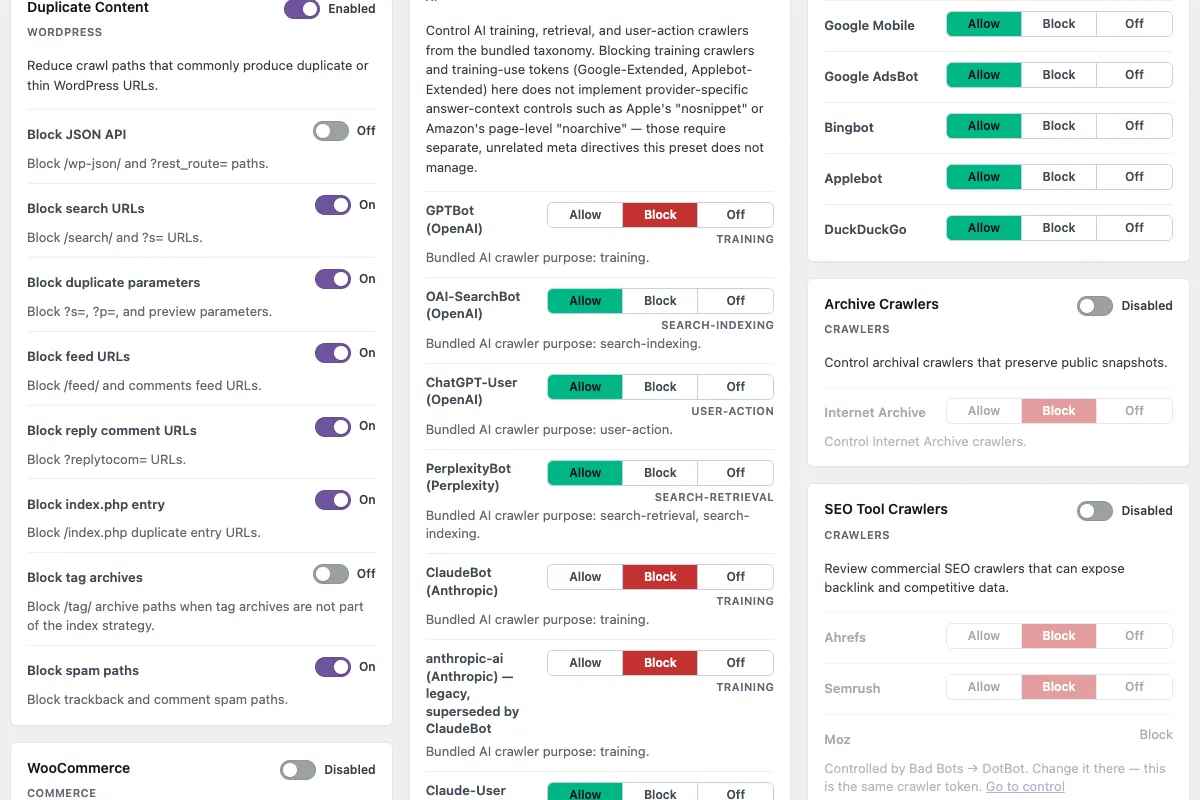
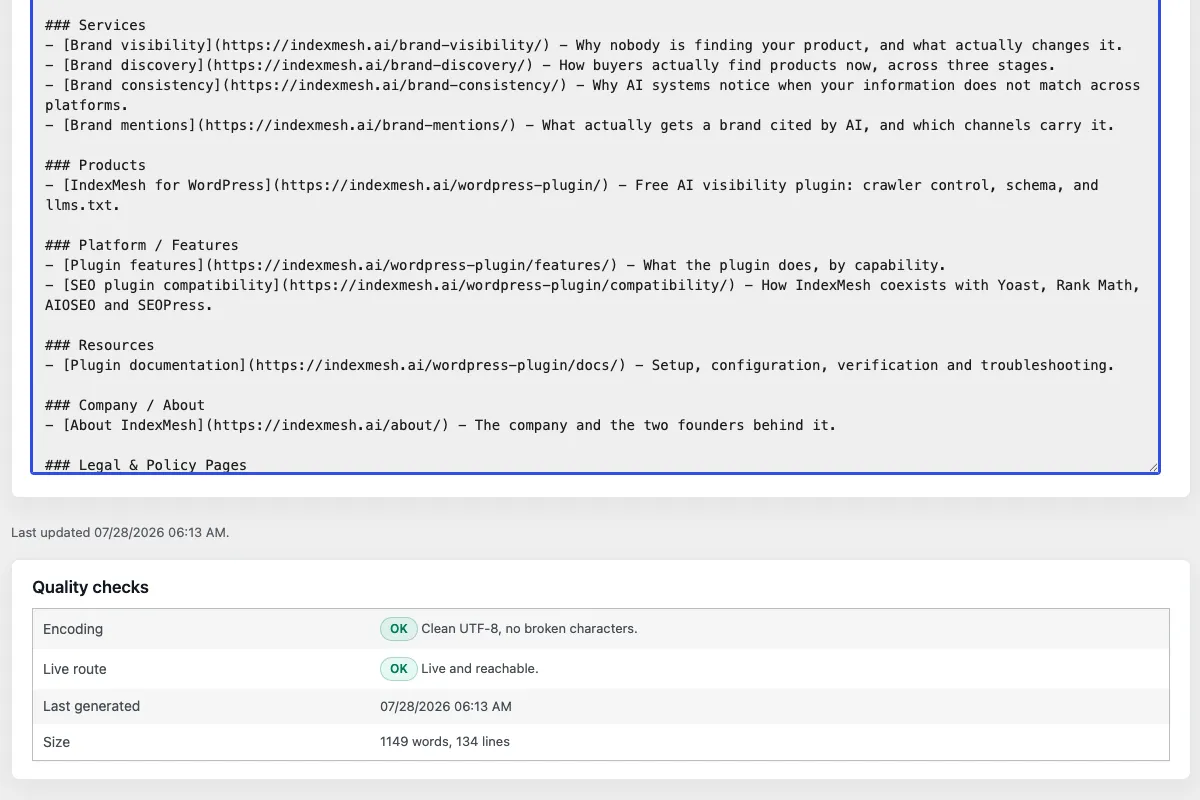
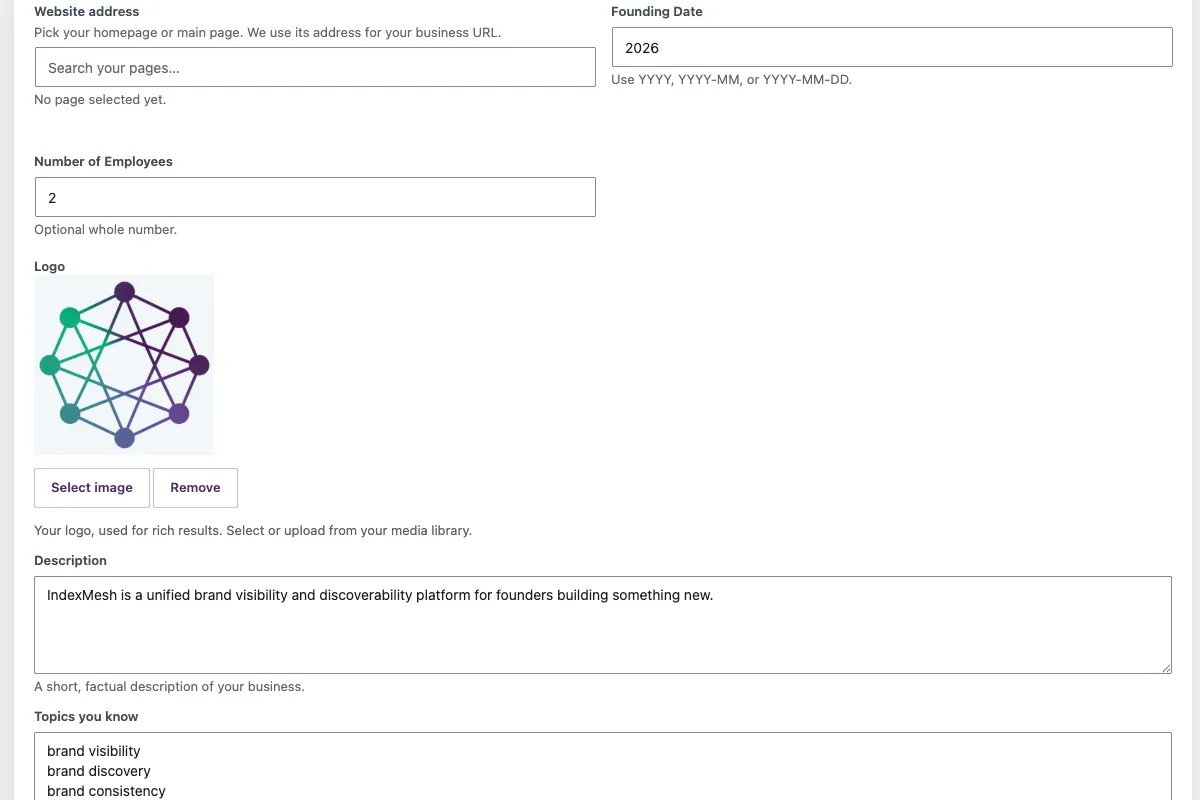
IndexMesh for WordPress is a free plugin covering three modules, each read from the same business record.
- AI crawler access. Allow, Block, or Off per agent, with preset groups so "block AI" stops being one decision and becomes several, keeping search and retrieval agents in while declining training crawlers.
- llms.txt. Guided sections for identity, offerings, and key pages, not a dump of your ten latest posts, with a live preview and conflict detection that defers by default if another plugin already owns the file.
- Organization and author schema. Reads what your SEO plugin already publishes and enriches it in place where it can, so two plugins never quietly publish two versions of who you are.
It works alongside Yoast SEO, Rank Math, All in One SEO, and SEOPress, or on plain WordPress: a read-only registry detects which one you run, and IndexMesh for WordPress never writes to another plugin's data.
It's available now, free, no account required.
See what it does Get it on WordPress.org See every control in detail →
Mesh AI, the platform that does the off-site work described above, is a separate product. The plugin works on its own and does not wait for it.
Mesh AI is the platform being built to do all of it.
Everything above is brand visibility work someone has to do by hand today. Mesh AI is what does it for you.
Mesh AI is being built as one system for all of it, rather than another tool to add to the list. It cannot make an AI system mention you, and we will not claim it can.
Mesh AI is in build. There is no launch date yet, and we will not invent one.
Building something now and want to talk before then? Leenat runs our operations and reads every message.
Available today: the IndexMesh WordPress plugin, which keeps the on-site half accurate and machine-readable.
Two founders, and client relationships older than most startups.
IndexMesh is a startup founded by Xavier Emerson and Leenat Rose, working with founders anywhere in the world. Xavier also builds production web platforms and custom applications for clients in the United States. Leenat runs people and operations across the same client base, several of those relationships have run six to thirteen years.
For company questions, Xavier can be reached at xavier@indexmesh.ai .
Xavier and Leenat can't hand-build brand visibility for a hundred companies alone, so IndexMesh was never designed that way. The software does the work, which keeps the company small, slow, and hard to kill.
Common questions
Eight questions people ask about what IndexMesh actually does.
Something not answered here?
What does IndexMesh actually do?
IndexMesh builds brand visibility for founders: the platforms, profiles, communities, and consistent identity that search engines and AI systems draw on when deciding what to say about you. The WordPress plugin handles the on-site foundation and is available now.
How is this different from other AI visibility tools?
Most monitor whether AI mentions you, or optimise your own site. Peec AI recommends moves but leaves you to execute them. Sight AI auto-publishes on-site content instead. Both skip the part that actually moves brand visibility: presence on platforms you don't own. That's what IndexMesh builds.
Why does my site rank on Google but never get mentioned by AI?
Ranking and being cited have come apart. An answer is assembled from sources, most of which aren't your website, and the ones that agree with each other are what a system leans on. A well-ranked site is one input among many.
Do you post on my behalf?
No. You review and publish everything from your own accounts. Nothing appears under your name that you haven't read first.
Do I need a marketing team to use this?
No. Everything is being built to be usable by a founder with no marketing support at all. If you do have a marketing team, or one marketer, it works the same way.
What if I need more than software?
IndexMesh is software, not an agency. We don't run campaigns, pitch journalists, or work on retainer. There's real SEO work inside it, auditing a site, fixing schema and entity signals, but it won't sell you rankings.
Will this get me ranked or cited by AI?
We won't promise that, and neither should anyone else. Search engines and AI systems decide what to do with the signals you publish. What we can do is make sure those signals are accurate, consistent, and actually working.
Why don't you publish a visibility score?
Because buyers have stopped trusting them. A 2026 Reddit thread describes six agency pitches, each with a "visibility score" nobody could explain. What moves the number is sources you don't own mentioning you, not a dashboard. We'd rather build that than sell you a score for lacking it.
Last updated
- Evidence last checked:
- Editorial guidance last reviewed:
This page is reviewed at least quarterly, since the AI-visibility research it cites is still being published.
We will tell you when it is ready.
One email when it is ready. After that, only when there is something genuinely worth reading. Unsubscribe in one click.