
One entity beats two: how schema markup for AI search settles the question
Schema markup for AI search states, in machine-readable form, who you are. The failure that costs you is not missing markup, it is two plugins on one site publishing two different answers.
Schema Markup for AI Search, in Short
- Schema states who you are in machine-readable form; it does not rank you, and no schema type is required to appear in an AI answer.
- The real risk isn't missing markup, it's two plugins on one site each publishing a competing Organization block with no way for a machine to tell which is authoritative.
- Ahrefs found no major citation uplift from adding JSON-LD across nearly 2,000 tested pages; schema removes ambiguity, it doesn't cause citation.
sameAsand a stable@idare what let separate schema nodes resolve to one entity instead of two.- IndexMesh for WordPress enriches your existing SEO plugin's schema graph through its own filters rather than publishing a second, competing one.
What schema markup actually does
Schema markup for AI search does one job: it states, in machine-readable form, what the page and the organisation behind it are.
It names you
Business name, logo, address, founders, the people who write the content. Stated as data, rather than left to be worked out from your page text.
It disambiguates you
Google documents identifier properties for an organisation and says some of them "are used behind the scenes to disambiguate your organization from other organizations", naming iso6523 and naics.
Google Search Central, Organization structured data, updated 15 April 2026
It does not rank you
Adding markup does not move you up, and no schema type is required to appear in an AI answer. Its job is identification, not competition.
Does schema get you cited by AI?
Five dated findings, including the most quoted statistic in this subject, which traces to no study at all.
| The claim | What the evidence says | Source and date |
|---|---|---|
| A special schema type is needed to appear in AI Overviews or AI Mode | "There’s also no special schema.org structured data that you need to add." Google adds that there are no additional requirements and no special optimisations for these features. | Google Search Central, AI features and your website, 10 December 2025 |
| Adding schema lifts AI citations | 1,885 pages that added JSON-LD between August 2025 and March 2026, matched against roughly 4,000 control URLs. AI Overviews −4.6%, AI Mode +2.4%, ChatGPT +2.2%. No major uplift on any platform. | Ahrefs, Louise Linehan and Xibeijia Guan, 11 May 2026 |
| AI systems read your JSON-LD when they fetch your page | A test page published the same prices in eight layers. At direct fetch, JSON-LD was extracted by 0 of the 5 systems tested: ChatGPT, Claude, Gemini, Perplexity and Google AI Mode. Visible HTML and visible microdata were. | searchVIU, test run, 30 October 2025 |
| Markup is what gets a page cited | Across 1.9 million citations in 1 million AI Overviews, Ahrefs found that the primary cited URL had a median organic position of 2. Cited pages tended to have strong existing organic visibility. That supports prioritising discoverability and ranking fundamentals. It does not demonstrate that schema markup causes AI citations. | Ahrefs, 21 July 2025 |
| Structured data and FAQ blocks produced a 44% increase in AI citations | A systematic review screening 120 records and 71 papers found no such study. The real BrightEdge 44% figure concerns something unrelated. The Princeton GEO paper cited alongside it tested nine methods, and structured data was not one of them. | Daniel Cheung, Should You Bother With Schema Markup for AI Search?, 6 July 2026 |
Ahrefs state their own limits: the sample was pages already receiving citations, the window was 30 days, and they leave open that schema may help pages that are not being retrieved at all.
Schema makes your identity unambiguous. That is a floor, not a lever.
The signals that travel with citation sit mostly off your own site. What gets a brand mentioned →
When your site publishes two different versions of you
Nothing errors, nothing warns, and the page still validates.
<script type="application/ld+json">
{
  "@context": "https://schema.org",
  "@type": "Organization",
  "name": "Acme Analytics",
  "url": "https://example.com/",
  "logo": "https://example.com/logo.png"
}
</script>

<script type="application/ld+json">
{
  "@context": "https://schema.org",
  "@type": "Organization",
  "name": "Acme Analytics Ltd",
  "url": "https://example.com",
  "logo": "https://example.com/uploads/acme-mark-2019.png"
}
</script>
Two names, two logos, two trailing-slash forms of the same URL. Both blocks are valid. Neither points at the other, so nothing in the page says these describe one organisation.
@id<script type="application/ld+json">
{
"@context": "https://schema.org",
"@graph": [
{
"@type": "Organization",
"@id": "https://example.com/#organization",
"name": "Acme Analytics Ltd",
"alternateName": "Acme Analytics",
"url": "https://example.com/",
"logo": "https://example.com/logo.png",
"sameAs": [
"https://www.linkedin.com/company/acme-analytics/",
"https://github.com/acme-analytics"
]
},
{
"@type": "WebSite",
"@id": "https://example.com/#website",
"url": "https://example.com/",
"name": "Acme Analytics",
"publisher": { "@id": "https://example.com/#organization" }
}
]
}
</script>One organisation with a stable @id, the second name carried by alternateName instead of contradicting the first, and the WebSite node referring to the organisation rather than describing it again.
Why it collides on every template: Google recommends Organization markup on the home page or on a single page that describes your organisation, and states that you do not need it on every page (Google Search Central, Organization structured data, 15 April 2026). WordPress SEO plugins emit it site-wide.
How common this is
Over 17 million WordPress sites run one of the four major SEO suites, and all four emit an Organization graph. A further 100,000 or more run a dedicated schema plugin that emits one as well.
WordPress.org plugin directory install counts, retrieved 26 July 2026
Everyone who writes about this treats it as an SEO hygiene bug. It is closer to an identity problem: the machine reading your page now has two answers to the question of who you are, and no way to choose between them.
The irony is that this usually happens to people who are trying harder than average. You do not end up with two schema graphs by neglecting your site. You end up there by installing a second tool to improve it.
Why contradicting yourself is worse than saying nothing
The largest schema producer on WordPress documents this problem itself, in guidance written for other plugin developers.
If you use a different approach (e.g., you output a structured JSON-LD tree, or use microdata), there's a risk that the various pieces might have conflicting information, and that the page isn't accurately represented.
Yoast developer portal, schema integration guidelines. The page carries no date; retrieved 26 July 2026.
What Yoast tells other developers to do instead
- Reference their @id. Point your nodes at the graph that already exists rather than starting a second one
- Filter their output. Add your data to the graph they build, through the filters they publish for it
- Reuse the same @id. So a consumer merges the pieces into one entity instead of reading two
That is written for developers building plugins. Nobody has said it to the site owner running three of them.
Which schema markup for AI search types matter
For most businesses it is four types: Organization, WebSite, Person for real authors, and Article on content pages, and getting those correct matters more than adding rarely used ones.
| Property | What it does | Documented or judgement |
|---|---|---|
name | The one form you use everywhere. Not "Acme" here, "Acme Ltd" there and "ACME" in a third place. | Documented. Google, Organization structured data, 15 April 2026 |
url and logo | Absolute URLs. Google states that logo can influence which image appears in Search results and in a knowledge panel. | Documented. Same source |
sameAs | URLs of pages on other sites carrying more information about your organisation. Multiple are permitted. Google documents no ranking or citation effect. | Documented. Same source |
Identifiers: duns, iso6523Code, leiCode, naics, taxID, vatID, globalLocationNumber | Google says some of these are used behind the scenes to disambiguate your organisation from other organisations. | Documented. Same source |
founder and address | Person references and a real postal address, which separate you from similarly named organisations. | Judgement. Google documents the properties, not the effect |
| Placement | The home page, or a single page describing the organisation. "You don’t need to include it on every page of your site." | Documented. Same source |
| Required properties | There are none. Google: "add the properties that apply to your organization." | Documented. Same source |
@id | A stable identifier, so separate nodes refer to one entity rather than describing two. Google documents it as the mechanism for linking related items on a page. | Documented. Google, structured data policies, 10 July 2026 |
More properties is not better. Correct and consistent properties are better.
Getting your own Organization graph right, without a second plugin quietly contradicting it, is what IndexMesh for WordPress manages in one place .
What sameAs is for
The sameAs property states that the entity described here and the entity on those other profiles are the same entity.
Where sameAs actually points
Of sites using sameAs, 4.53% point at Facebook, 3.67% at Instagram, 1.11% at LinkedIn and 0.17% at Wikidata.
HTTP Archive Web Almanac 2024, structured data chapter, 11 November 2024
What is worth listing
- Your company profiles. LinkedIn, GitHub, Crunchbase, the platforms you actually maintain
- Your entry in an entity database. Your Wikidata item, if one exists for you
- Not everything you have ever registered. A dead profile you do not update is a claim you are not maintaining
Judgement, not documented behaviour: whether a Wikidata link improves how an AI system resolves your entity is industry belief. Google documents the property and documents no citation effect for it.
On-site markup is where your identity is stated. The rest of the web is where it is corroborated.
Schema states your facts on the site you control. The same facts have to match on the platforms you do not. The off-site half →
Is FAQ schema still worth adding?
Yes, for answer engines, though not for the reason people assume. Google's FAQ rich result is gone from Search entirely, so FAQPage markup will not win you the rich snippet it used to. It remains a valid Schema.org type, and it's still how you hand an AI system a clean, liftable question-and-answer pair.
- August 2023. FAQ rich results restricted to well-known, authoritative government and health sites
- 7 May 2026. FAQ rich results stopped showing in Google Search
- 8 May 2026. A deprecation notice added to Google’s FAQ documentation
- 15 June 2026. The documentation removed entirely. FAQPage is not in Google’s supported structured data gallery
- June 2026. The Rich Results Test and the Search Console FAQ filter dropped support
- August 2026. Search Console API support ends
- Today. FAQPage remains a valid Schema.org type, and answer engines are not Google rich results
Google Search Central changelog and Search Engine Land, 7 May and 15 June 2026
So we ship the markup for answer engines rather than for rich results, including on this page, which carries FAQPage and will not produce one. Bing's February 2026 guidance points the same way: it recommends clear headings, tables and FAQ sections as content structure, not as markup.
How to check what schema your site is emitting
Most people never look, and what you configured is frequently not what you serve when it comes to schema markup for AI search.
View the page source and search for application/ld+json.
Every match is a schema block. Count the Organization nodes. More than one and you have diagnosed the problem in about ten seconds.
Run the URL through validator.schema.org.
The Schema Markup Validator parses any Schema.org type, which makes it the right tool for auditing an organisation graph.
Then Google’s Rich Results Test, second.
It tests only Google-supported rich result types, and it stopped supporting FAQ in June 2026, so valid FAQPage markup shows nothing there.
Check more than the homepage.
Article pages, author archives and product pages often emit different graphs, and duplication frequently appears on one template and not another.
Check what is served, not what is configured.
Fetch the live URL rather than trusting the admin screen. A caching layer can serve older HTML carrying older markup.
For citation reporting, Bing Webmaster Tools AI Performance.
In public preview since 10 February 2026, it reports which of your URLs are cited in Copilot and Bing AI answers. It is the only first-party AI-citation reporting surface we could locate.
What IndexMesh does, per provider
Its behaviour depends on what you already run. Six states, and two of them end in IndexMesh for WordPress publishing nothing at all.
Yoast SEO, Rank Math or All in One SEO
- What IndexMesh does
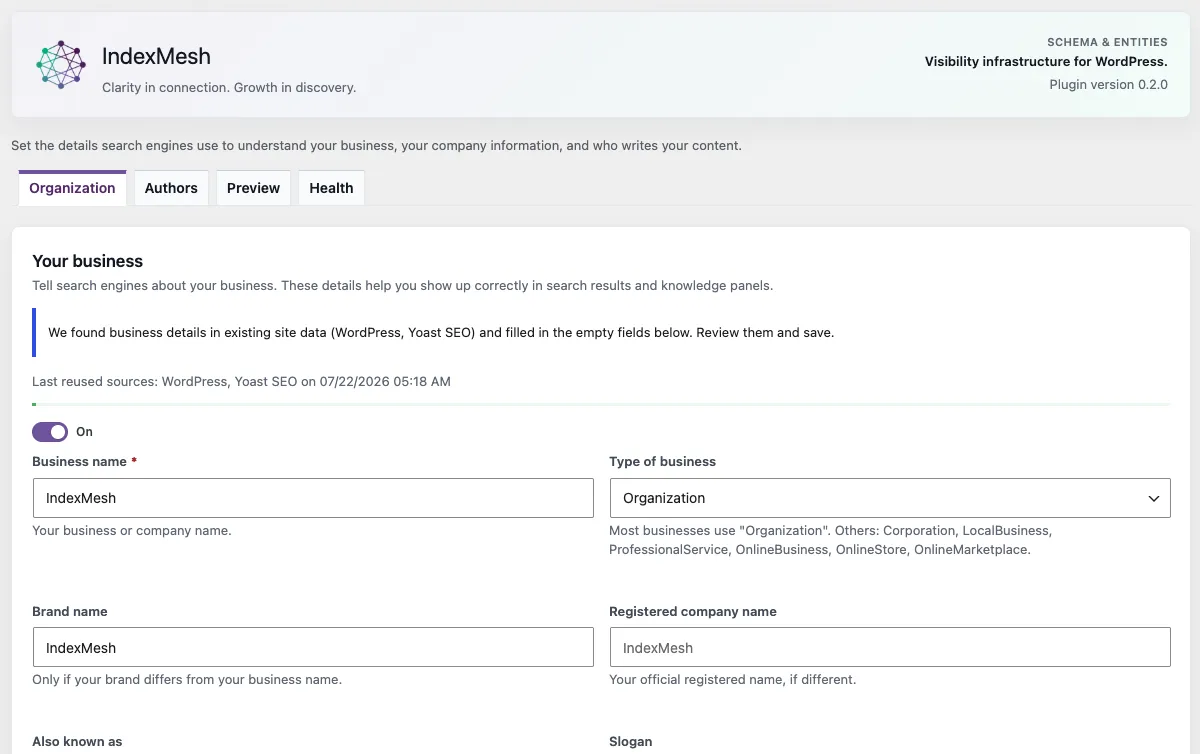
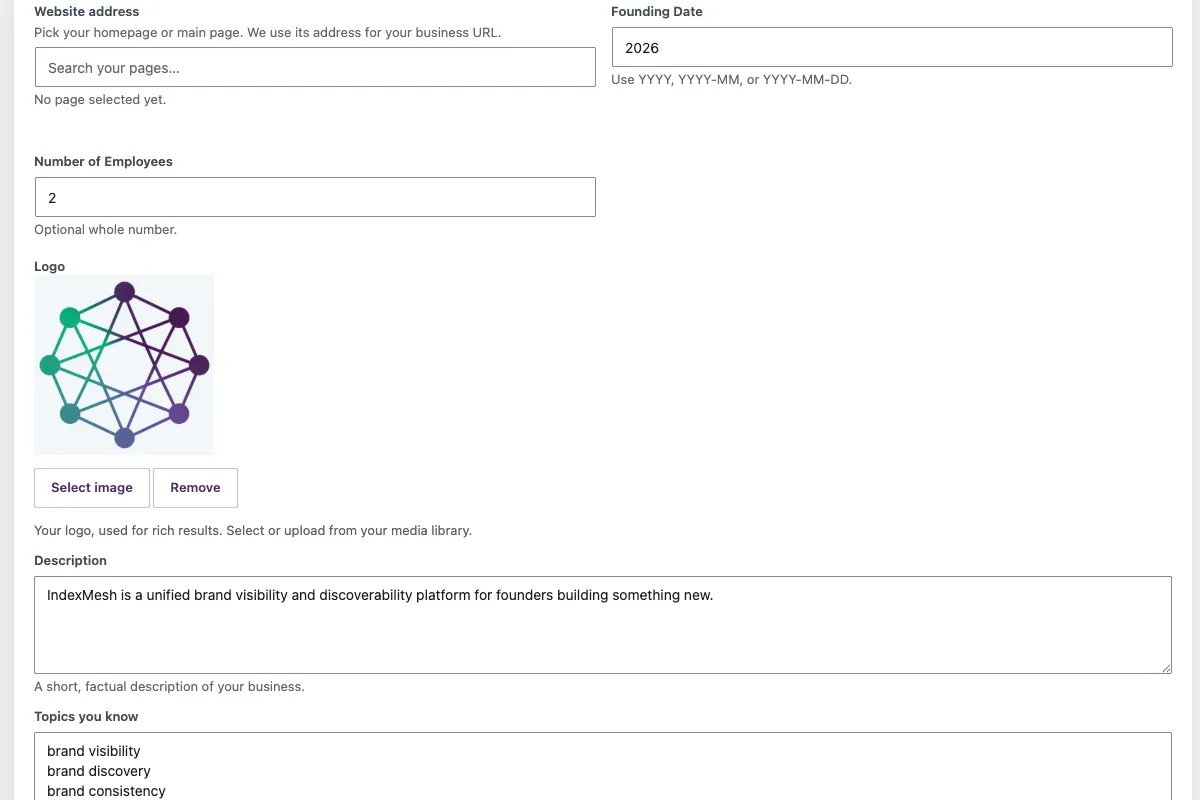
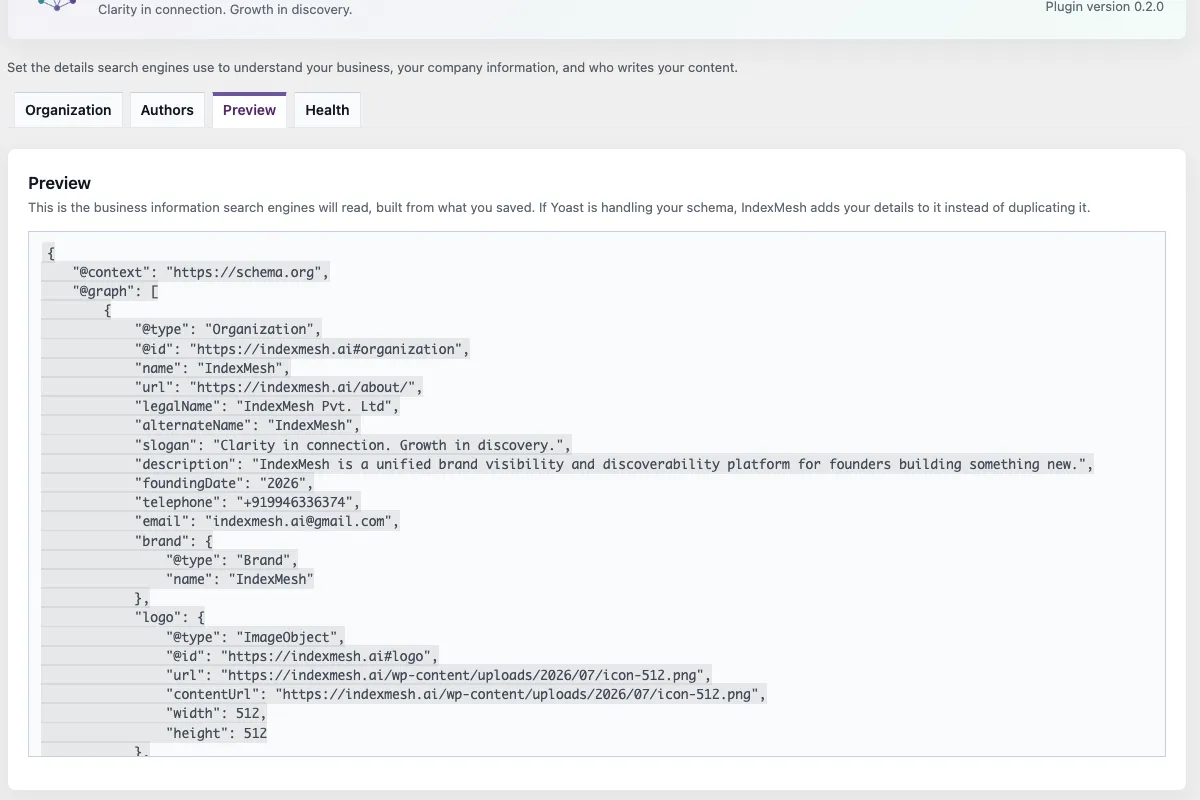
- IndexMesh for WordPress enriches the provider's own graph in place, through its public filters. Existing Organization, Person and Article nodes are enriched, and a genuinely missing eligible node is appended inside the provider's graph. No separate graph of its own is printed
SEOPress
- What IndexMesh does
- IndexMesh for WordPress enriches the existing Organization and Article nodes in place, through SEOPress's own filters. SEOPress exposes no whole-graph append filter, so an eligible node that cannot be inserted that way, such as an opt-in FAQ node, may be published in a separate supplemental block. An author ProfilePage is held back unless you confirm SEOPress does not already output one. Organization and Article are not repeated there
Plain WordPress
- What IndexMesh does
- The plugin publishes eligible IndexMesh-owned JSON-LD directly. There is no provider graph to enrich
A detected provider that owns a schema graph but has no IndexMesh adapter
- What IndexMesh does
- The plugin publishes eligible standalone JSON-LD rather than silently dropping the configured data, and says so in Schema Health
Schema ownership it cannot determine
- What IndexMesh does
- The plugin emits and enriches nothing. It defers rather than guessing
Two or more third-party schema providers
- What IndexMesh does
- The plugin suppresses its own output and enrichment rather than adding to an ambiguous provider state
In every case, provider @id values and provider-owned field values are preserved, and an IndexMesh Organization is only added when the provider graph does not already have one.
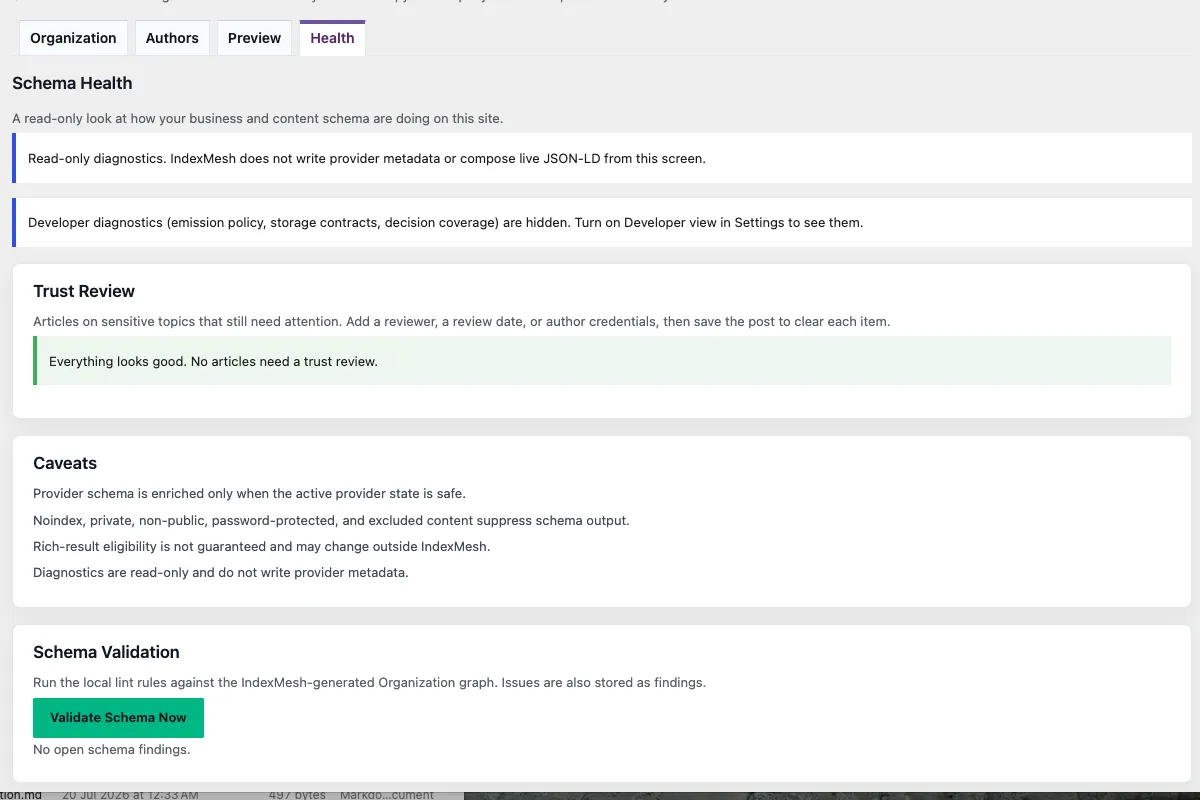
How this works alongside what you already run
Keep the SEO platform you already trust. IndexMesh for WordPress is not another one: it is an AI-discovery governance layer that sits around it.
Yoast SEO
- What it already provides
- A strong connected schema graph covering Organization, Person, WebSite, WebPage, Article, FAQ, HowTo and other supported types
- How IndexMesh for WordPress differs
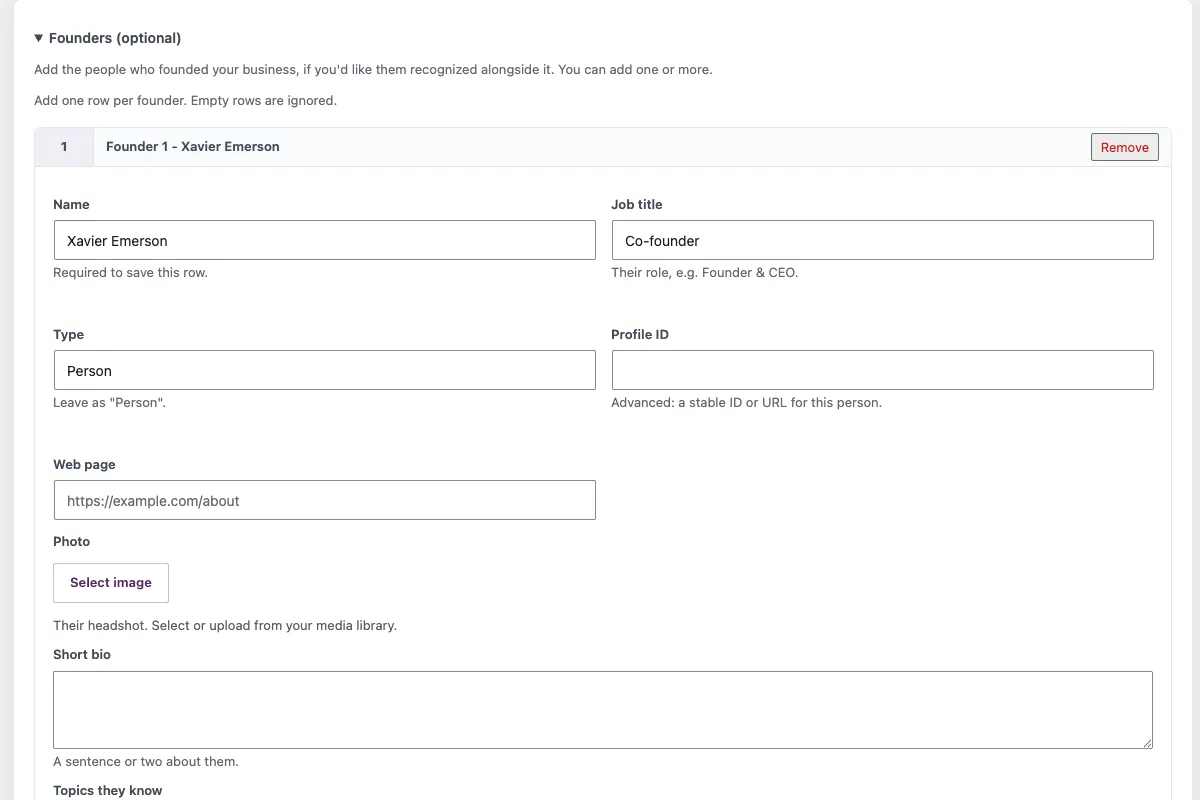
- Guided organisation and entity setup, prefill from WordPress and detected site values, business identifiers and official profiles, founders and sub-organisations, offices, addresses and policies, author trust profiles with completion guidance, and Article about, mentions, reviewer and lastReviewed context
- How they coexist
- Yoast owns and connects the graph. The plugin adds that context through Yoast's own public schema filters rather than asking you to replace it
Rank Math
- What it already provides
- Its own connected graph
- How IndexMesh for WordPress differs
- The same guided entity context
- How they coexist
- Whole-graph enrichment through the provider's filter
All in One SEO
- What it already provides
- Its own connected graph
- How IndexMesh for WordPress differs
- The same guided entity context
- How they coexist
- Whole-graph enrichment through the provider's filter
SEOPress
- What it already provides
- Its own graph, with per-node filters
- How IndexMesh for WordPress differs
- The same guided entity context
- How they coexist
- Organization and Article enriched in place. An eligible node SEOPress cannot accept is published separately with its own identity
Plain WordPress
- What it already provides
- No entity graph
- How IndexMesh for WordPress differs
- The whole module
- How they coexist
- The plugin publishes eligible JSON-LD itself, since there is no graph to enrich
Yoast owns the graph. IndexMesh for WordPress deepens what is in it.
The test is not how many script blocks a page has. It is whether two of them claim to be the same thing.
Pages routinely carry several JSON-LD blocks and that is normal. What causes the damage is two definitions of one entity, conflicting values, or the same thing given two different identifiers. That is what these rules exist to prevent.
- It checks the page as served. Validation fetches the published page and checks the emitted schema against the HTML a visitor receives, which is where the admin screen and the served page diverge
- FAQ schema is per post and opt-in. Detected from a local FAQ source, and suppressed when another plugin's FAQ block is already on the page
Why this page treats schema as identity, not a ranking lever
IndexMesh's founders, Xavier Emerson and Leenat Rose, built the free IndexMesh for WordPress plugin on the same distinction this page draws: markup states who you are, it does not buy you a citation or a ranking. That is why IndexMesh for WordPress enriches your existing SEO plugin's schema graph instead of replacing it with a supposedly better one, and why every claim above cites what Google, Ahrefs, searchVIU, and Yoast actually document rather than what would be convenient to promise.
Common questions
Eight questions people ask before trusting a schema plugin to describe their business correctly.
Can two plugins both output schema on the same page?
Yes, and it happens easily. Each publishes its own application/ld+json block. Nothing errors and the page still validates, which is why it goes unnoticed. Search your page source for application/ld+json and count the Organization nodes.
Does duplicate schema hurt SEO?
Google publishes no guideline, penalty or warning about two Organization graphs on one page. Its structured data policies cover invisible, misleading and irrelevant markup instead. What duplication costs you is clarity: two conflicting descriptions leave a machine no way to choose between them.
Does adding schema get me cited by AI?
No. Ahrefs tracked 1,885 pages that added JSON-LD against roughly 4,000 control pages and found no major citation uplift on any platform (11 May 2026). Google states no special schema.org markup is needed (10 December 2025). Schema removes ambiguity, and does not cause citation.
Did Google kill FAQ schema?
Google retired the FAQ rich result: gone from Search 7 May 2026, documentation removed 15 June 2026. FAQPage remains a valid Schema.org type, and answer engines are not Google rich results, so we still ship the markup here, without expecting a rich result.
Should I use Organization or Person schema?
Organization for a business, even a one-person business with a real trading name. Person for the individuals: founders and authors. Most sites need both, linked to each other with stable @id values.
Where should Organization schema go on my site?
Google recommends the home page, or a single page that describes your organisation such as an about page, and states you don't need it on every page (15 April 2026). WordPress SEO plugins emit it site-wide, which is why a second emitter collides on every template.
What is sameAs and does it matter?
It lists URLs of pages elsewhere that carry more information about the same entity: your LinkedIn company page, your GitHub organisation, your Wikidata item. Google documents the property with no ranking or citation effect. It matters because it states the connection instead of leaving a machine to infer it.
How do I see what schema my site is currently emitting?
View the page source and search for application/ld+json, then run the live URL through validator.schema.org. Check several page types rather than only the homepage, and fetch the live URL rather than trusting the admin screen.
Last updated
- Evidence last checked:
- Editorial guidance last reviewed:
We review this reference at least quarterly and sooner when the underlying evidence changes.
Google changed its FAQ position twice in 2026 and the evidence on schema and AI citation moved in May 2026.
Keeping one entity rather than two
The duplicate-entity problem this page describes is the one the IndexMesh WordPress plugin was built to avoid.
- Enriches, rather than competes. It works through your SEO provider's own public filters. Where a provider cannot accept an extra node, that node is published separately without repeating your Organization
- Defers when ownership is unclear. If schema ownership cannot be determined, or two third-party providers are active, the plugin suppresses its own output rather than guessing
- Checks the served page. Organisation and author details in one place, verified against the published page rather than the admin screen
Free, and it works with Yoast SEO, Rank Math, All in One SEO, SEOPress and plain WordPress.
Manage organisation and author schema in WordPress →
The WordPress plugin is one of two IndexMesh products, and it is the one you can have today. It handles the on-site half of the identity problem. The corroboration this page describes happens off your domain.

We will tell you when it is ready.
One email when it is ready. After that, only when there is something genuinely worth reading. Unsubscribe in one click.